How to Beat Decision Fatigue
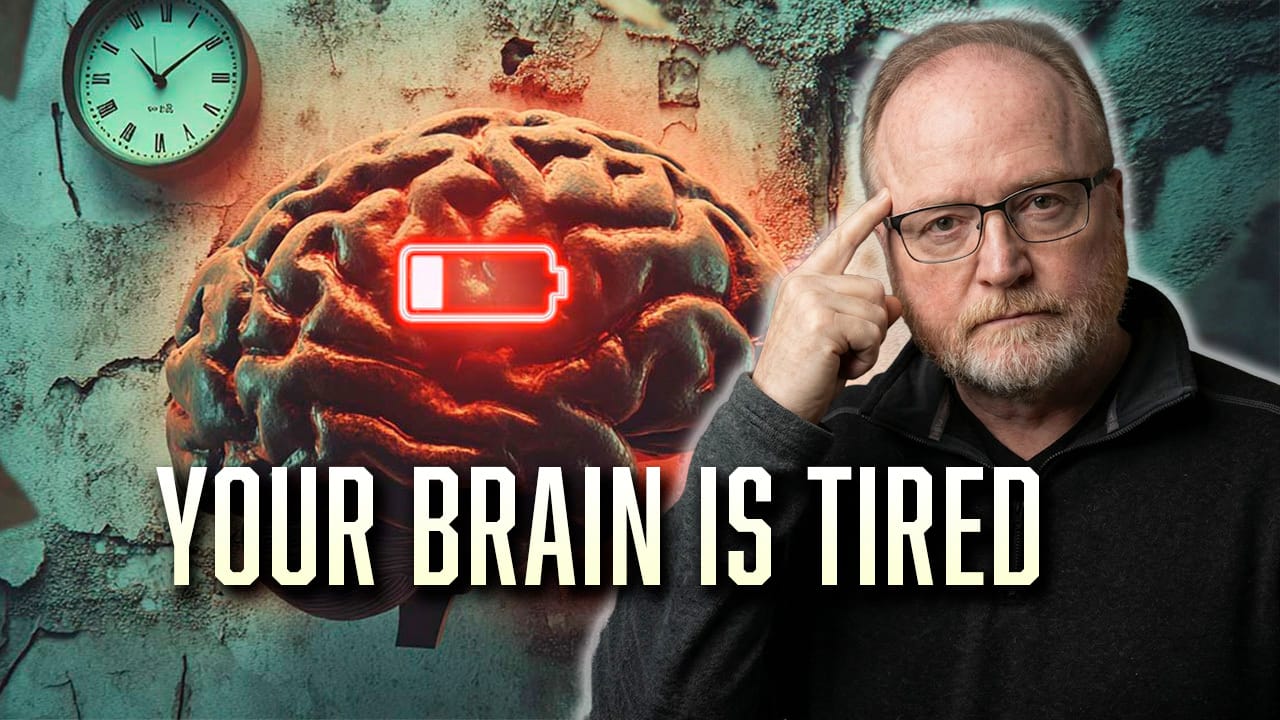
Your brain doesn't shut down when it's tired. It quietly lowers its standards and never tells you.

A nurse in Pennsylvania had been on her feet for twelve hours. She was supposed to go home, but the unit was short-staffed, so she stayed. During that overtime, a patient was diagnosed with cancer and needed two chemotherapy doses. She administered the first, placed the second in a drawer, and headed home.
She forgot about the second dose.
It wasn't discovered until the next day. The patient was fine; they got the treatment in time. But think about what happened. This wasn't a careless nurse. This was a dedicated professional who stayed late to help her team. Her skills didn't fail. Her knowledge didn't fail. Her energy failed, and her judgment went with it.
That's the trap. We assume our thinking stays constant, that the brain in hour fourteen is the same brain that showed up in hour one. It's not.
Last episode, we tackled deciding under uncertainty. But fatigue does something different. Uncertainty makes you hesitate. Fatigue makes you stop caring.
... or listen to the audio podcast
Why Your Brain Makes Worse Decisions by Evening
You've probably heard the popular saying: "Making too many decisions wears you out, so by evening your judgment is shot."
That idea dominated psychology for twenty years. Researchers believed decision-making drained from a limited mental reserve, like a battery running down.
Then, independent labs tried to reproduce those results at scale, and the effect vanished. One study, 23 labs, over 2,000 people, found nothing. A second, 36 labs, 3,500 people, same result.
The experience is real, though. People do make worse decisions after a long day of mental effort. What was wrong was the explanation. Your brain doesn't drain like a battery. After sustained effort, it shifts priorities. It starts favoring speed and ease over accuracy. Not because it can't think carefully, but because it decides careful thinking isn't worth the effort.
Decision fatigue isn't your brain shutting down. It's your brain quietly lowering its standards without telling you.
Enjoying this? Studio Notes delivers innovation decision insights to your inbox.
Decision Fatigue in the Real World
That science isn't abstract. It plays out every day.
Researchers at Brigham and Women's Hospital tracked over 21,000 patient visits. Doctors prescribed unnecessary antibiotics more frequently as the day went on. Not because afternoon patients were sicker. Because saying "here's a prescription" is easier than explaining why you don't need one. Five percent more patients received antibiotics they didn't need, purely because of timing.
The same pattern shows up everywhere. Surgeons make more conservative calls later in the day. Hand hygiene compliance drops across a twelve-hour shift. Financial analysts grow less accurate with each additional stock prediction they make in a single day. The drift always goes in the same direction: toward whatever requires the least effort.
That drift explains something we've been exploring across this series. When you're exhausted, someone else's conclusion isn't just tempting, it's a relief. The algorithm's recommendation saves you from having to evaluate. The expert's opinion saves you from forming your own. That's mindjacking, finding the open door. Fatigue doesn't just degrade your thinking. It makes you grateful to hand it over.
Your Four Warning Signals
Knowing the science is useful. But what matters more is catching fatigue in yourself before it costs you. Here are four signals that your judgment is compromised.
Signal 1: The Default Drift. Someone proposes a plan that sounds... fine. Not great, not terrible. Two hours ago, you'd have pushed back, asked harder questions. Now you just nod. You're not agreeing because you're convinced. You're agreeing because disagreeing takes energy you no longer have.
Signal 2: The Irritability Spike. A colleague asks a reasonable question, and it feels like an interruption. When your emotional response is out of proportion to the situation, it's not the situation. Your reserves are low.
Signal 3: The Shortcut Reflex. A decision that should take twenty minutes takes thirty seconds. You skip the analysis, go with your gut. There's a version of this that sounds like confidence. "I trust my instincts." But late in the day, that phrase is often code for "I'm too tired to think this through."
Signal 4: The Surrender. You stop forming conclusions and start borrowing them. Someone says, "I think we should go with Option B" and you feel a wave of relief. Not because Option B is right, but because you no longer have to figure it out. That relief is the signal. When outsourcing, your judgment feels like a gift instead of a loss, you're running on empty.
If two or more of these show up at the same time, stop. Your judgment isn't reliable right now. Don't trust it with anything that matters.
Four Moves to Protect Your Judgment
Those signals tell you something's wrong. Here's what to do about it.
Move 1: Postpone it. Move the decision to a high-energy window. For most people, that's morning. Think of those hours like premium real estate. Stop filling them with trivial meetings.
Move 2: Shrink it. Instead of "Should we pursue this entire strategy?" ask "What's the one thing I need to decide tonight?" Tired minds handle focused questions better than open-ended ones.
Move 3: Add a checkpoint. Make the call, but build in a mandatory review: "Here's my decision. We revisit on Thursday morning." Not indecisiveness. A safety net.
Move 4: Pre-commit. Before you're ever exhausted, set rules for your future tired self. "I don't approve expenditures over $10,000 after 6 PM." "I don't respond to emotionally charged emails the same day." "I don't make personnel decisions on Fridays."
This is the most powerful move because you're making the decision when you're strong so you don't have to make it when you're weak.
Pre-commitment also means structuring the order of your decisions. Researchers studying car buyers found that customers who faced the most complex choices first were significantly more likely to accept defaults on everything that followed. The decisions wore them down. The fix was simple: put simple choices first.
Front-load your high-stakes choices the same way. Design your day so that by the time your energy fades, the remaining decisions matter least.
Recovery as a Decision-Making Strategy
Everything I've just described helps you manage fatigue in the moment. But there's a deeper question: what are you doing to actually replenish?
We treat fatigue like it's inevitable. It's not. It's a sign you're spending more than you're recovering. The fix isn't another productivity hack. It's genuine rest. Real time away. Disconnected. Off.
I learned this the hard way. Early in my career, I was a workaholic, just like my father. It took years to see the connection between rest and judgment. When I became a CEO, I made recovery a priority. We offer unlimited PTO, but offering it isn't enough. I take it visibly, because if the person at the top doesn't step away, nobody believes they're allowed to. A team that never replenishes is permanently operating in a degraded state. That's slow-motion failure.
The triage framework buys you time. Recovery is what actually refills the tank.
Your Pre-Commitment Challenge
Every framework in this series assumes you'll use it when it counts. But mental fatigue is the silent killer of good frameworks. You can know everything about logical reasoning and second-order effects, and still make a terrible call at 10 PM because your mind decided careful thinking wasn't worth the effort.
That's why this isn't just another episode. This is the one that determines whether everything else actually works in your real life.
So, before this episode ends, pick one pre-commitment. One rule your strong self creates for your tired self. "I don't approve budgets after 7 PM." "I don't reply to conflict emails the same day." Whatever yours is, write it where you'll see it when you're exhausted. Then tell one person. Not for accountability theater. Because saying it out loud makes it real in a way that thinking it never does.
Remember that nurse? She had the knowledge, skills, and dedication to stay late for her team. What she lacked was a system to protect her judgment when her energy failed.
Your worst decisions don't happen because you're not smart enough. They happen because you're too tired to use the intelligence you already have.
That nurse had all night to realize what she'd missed. But what if she hadn't? What if someone had needed that decision in the next five minutes?
That's a different kind of danger. Not fatigue alone, but fatigue with a ticking clock. "We need an answer by the end of the day." "This offer expires at midnight." "The board meets tomorrow."
Sometimes those deadlines are real. Sometimes they're manufactured to make you decide before you can think. How do you tell the difference? That's next time. Subscribe so you don't miss it.
Before You Go
If you haven't written down your pre-commitment yet, do it now. Sticky note, phone, back of your hand — I don't care where. Then tell someone.
If mindjacking is a new concept for you, I've got a full episode that breaks down how to spot when your thinking has been hijacked, whether by outside forces or by yourself. Link's below.
One question for the comments: What's your pre-commitment? Drop it below. Make it public. Make it real.
The best decision you make today might be the one you don't let your exhausted self make tonight.
Never miss a post from Studio Notes
Get innovation decision insights delivered to your inbox. Free or paid — your choice.
Sources:
Berxi/NCSBN case studies: Pennsylvania nurse fatigue incident (chemotherapy administration error) https://www.berxi.com/resources/articles/medication-errors-in-nursing/
Linder, J.A., et al. (2014). Time of Day and the Decision to Prescribe Antibiotics. JAMA Internal Medicine, 174(12), 2029-2031. https://jamanetwork.com/journals/jamainternalmedicine/fullarticle/1910546
Hagger, M.S., et al. (2016). A Multilab Preregistered Replication of the Ego-Depletion Effect. Perspectives on Psychological Science, 11(4), 546-573. https://journals.sagepub.com/doi/10.1177/1745691616652873
Vohs, K.D., et al. (2021). A Multisite Preregistered Paradigmatic Test of the Ego-Depletion Effect. Psychological Science, 32(10), 1566-1581. https://journals.sagepub.com/doi/10.1177/0956797621989733
Levav, J., et al. (2010). Order in Product Customization Decisions: Evidence from Field Experiments. Journal of Political Economy, 118(2), 274-299. https://www.journals.uchicago.edu/doi/10.1086/652463
Dai, H., et al. (2015). The Impact of Time at Work and Time Off From Work on Rule Compliance: The Case of Hand Hygiene in Health Care. Journal of Applied Psychology, 100(3), 846-862. https://pubmed.ncbi.nlm.nih.gov/25365728/