How To Build a Decision System That Protects Your Thinking
The best decision-makers aren't smarter. They control when, where, and how they decide. Here's the system that makes that possible.

The best decision-makers aren't better at deciding. They're better at controlling when, where, and how they decide. It took me twenty years to figure that out.
Most people spend that time trying harder: more discipline, more willpower, more resolve to think clearly under pressure. It doesn't work. That's when mindjacking wins. Not through force. Through the door you left unguarded.
The answer isn't trying harder. It's building systems that protect your thinking before the pressure hits. By the end of this episode, you'll have four concrete strategies for doing exactly that, and a one-page system you'll build before we're done. And I have something else to share at the end. Something I've been working toward for twenty years.
Let's get into it.
... or listen to the podcast at:
Why Willpower Fails and Design Works
Ulysses knew his ship would pass the island of the Sirens. He also knew the song was irresistible. Sailors who heard it became incapacitated and drove straight into the rocks.
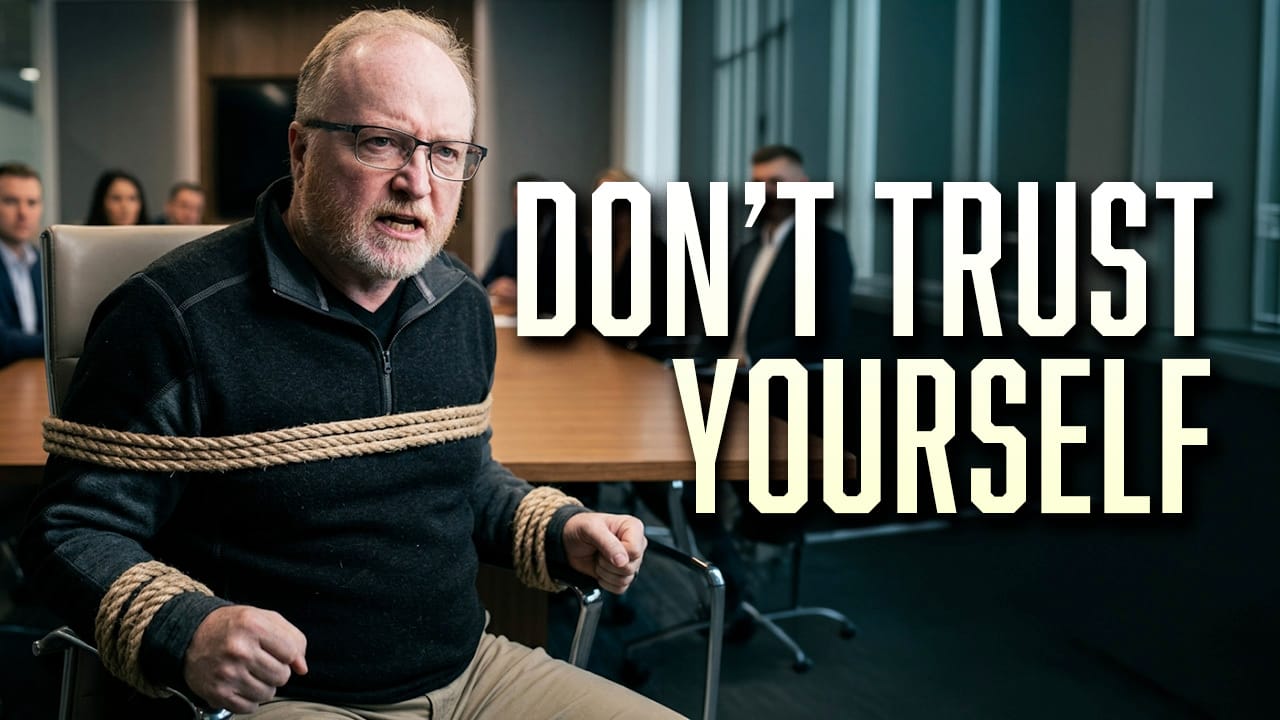
He didn't try to be stronger than it. He had his crew fill their ears with wax and tie him to the mast, with strict orders not to release him, no matter what he said when the music reached him.
His calm self setting rules for his compromised self. That's the core of everything in this episode.
These are called commitment devices. The decision gets made early, when your thinking is clear, before you're tempted to take the wrong path. Studies tracking self-imposed contracts found that when people added meaningful stakes to their commitments, their follow-through nearly doubled. Not because they became more virtuous, but because they'd taken the choice off the table at the moment they were most likely to get it wrong.
Stop asking "How do I resist?" Start asking, "What can I decide now, so I don't have to decide under pressure?"
Before you can build the right commitments, you need to know exactly where your thinking breaks down. Not decision-making in general. Yours.
Enjoying this? Studio Notes delivers innovation decision insights to your inbox.
Finding Your Personal Vulnerability
Think back across the last few months. Where did your thinking most clearly cost you?
Some people stall. They keep researching past the point of useful information, using "I need more data" as cover for avoiding a commitment they know they need to make.
Others make their worst calls at the end of long days. Saying yes when they mean no, because no requires energy they've already spent.
Some get caught by urgency. A deadline appears, the pressure closes off their thinking, and they move fast. Only later do they discover the deadline was manufactured to do exactly that.
Others walk into a room with a clear position and walk out agreeing with the loudest voice, unable to explain exactly when they shifted.
And some defend decisions past the point where the evidence says stop, because stopping would mean admitting something about themselves they're not ready to face.
Identify yours. Write it down before we go further. Your primary vulnerability is a design target, not a character flaw. You can't build around something you haven't named.
Four Strategies for Protecting Your Judgment
Strategy 1: Control When You Decide
Every morning I put on the same thing: a black golf shirt, blue jeans, and cowboy boots. Same brands, same routine, no decisions. My wife tolerates it. I've stopped apologizing for it.
It's not a fashion choice. It's a cognitive load choice. Your brain has a finite amount of decision-making capacity each day. Every trivial choice draws from the same reserve you need for the decisions that actually matter. What to wear, what to eat, which route to take. Eliminating those choices doesn't just save time. It protects the mental fuel you'll need later.
Decision-making capacity isn't flat across the day. It peaks early, when you're rested and fresh. It degrades, measurably, as conditions erode. The same call made at 8 a.m. and at the end of your seventh consecutive meeting aren't equivalent. Same person, different machine.
Pull up your calendar from the last two weeks. Look at when your biggest decisions actually happened. For most people, it's not in a calm moment with a clear head. It's in the hallway, on a rushed call, in the last fifteen minutes of a meeting that ran over. That's not bad luck. That's the default you haven't changed yet.
Write a standing rule: no significant, hard-to-reverse commitments after a certain hour or after a certain number of back-to-back meetings without a mandatory pause. Hold it like a policy, not a preference. Because preferences are exactly what disappear under the conditions where you need them most.
Strategy 2: Build Your Kitchen Cabinet
One of the things I credit most for whatever success I've had in my career isn't a framework or a methodology. It's four people.
I call them my kitchen cabinet. They've seen my best decisions and my worst ones. They know when I'm rationalizing. They know when I'm avoiding. And they are not afraid to call me out when I'm off the tracks.
Here's what surprises people when I describe them. They're not senior executives. They're not peers from inside my industry. They don't work in any organization I've ever worked for. They're a deliberate mix: different backgrounds, different areas of expertise, different ways of seeing the world. One of them has been in my cabinet for nearly thirty years. I trust them completely, and everything we discuss stays between us.
That independence is the whole point. The people inside your organization have something at stake in your decisions. Your peers have their own agendas, even when they don't mean to. Your boss has a preferred outcome. None of that makes them bad advisors. It just means they can't give you the one thing you need most when a decision gets hard: a perspective with no skin in the game.
Your kitchen cabinet can. Because they have nothing to gain or lose from what you decide, they can ask the question everyone else in the room is avoiding. They can tell you what you don't want to hear. And they'll do it before you've committed, when it still matters, not after the fact, when all they can do is watch.
Build yours deliberately. Four to six people is enough. Prioritize independence over seniority. Look for people who will push back, not people who will reassure. And make the relationship reciprocal. You show up for their decisions too. The cabinet only works if the trust runs both ways and the conversations stay private.
You don't need them for every decision. You need them for the ones where you're most at risk of fooling yourself.
Strategy 3: Write Your Position Before the Room Fills Up
I've sat in enough rooms where I walked in with a clear position and walked out having said almost none of it. Not because I was wrong. Because by the time the senior voice spoke and the heads started nodding, my own analysis felt less certain than it did twenty minutes earlier. The brain doesn't just nudge your answer when social pressure arrives. It rewrites your perception. What you saw before entering the room changes to match what the room already believes, before you've consciously registered the pressure.
Before any consequential group decision, write down where you stand. Three sentences. What you believe. What evidence supports it. What would genuinely change your mind. A note on your phone is enough. It doesn't need to be formal. It needs to be external, because your memory will quietly revise itself once the social pressure arrives. Those three sentences are a record of what you actually concluded before the room had a chance to work on you.
When the discussion moves toward a position, you can then distinguish between "I'm updating because I heard something new" and "I'm caving because the silence is uncomfortable." Without that record, those two experiences feel identical in the moment, and one of them will reliably win.
Strategy 4: Assume the Failure Before You Commit
In August 2016, Delta Air Lines ran a routine scheduled test of the backup generator at their Atlanta data center. A transformer caught fire. Three hundred of Delta's 7,000 servers, improperly connected to a single power source, went dark. They couldn't fail over to backups. The servers that stayed online couldn't communicate with the ones that hadn't. The entire system collapsed: passenger check-in, baggage, websites, kiosks, and airport displays. Gone.
Delta cancelled 2,100 flights over three days. $150 million in losses. Thousands of passengers slept on airport floors.
The system had redundancy designed in. The backup had been tested. The specific failure mode, servers with no alternate power connection, was a known vulnerability that nobody had ever stopped to question.
A year before the fire, cognitive psychologist Gary Klein, the researcher who developed the pre-mortem, had written a thought experiment describing almost this exact scenario. Imagine, he wrote, that an airline CEO gathered top management and asked: "Every one of our flights around the world has been cancelled for two straight days. Why?" People would think terrorism first. The real progress, Klein said, would come from mundane answers: a reservation system down, a backup that didn't activate, a cascade nobody had traced in advance.
Delta built what Klein described. Without running the question that would have found it.
The pre-mortem is that question. Before you commit to a significant decision, assume it's six months later, and the decision failed. Not possibly, but definitely. Then ask: What went wrong? What did you know but not say? What did someone sense but find too awkward to raise in the room?
"What could go wrong?" produces hedged answers. People soften concerns to preserve harmony. "It failed. What happened?" changes the psychology entirely. You're not being negative. You're being forensic. The things that surface, the concerns that felt impolitic, the risks that seemed too small to mention, are frequently the ones that end up mattering most.
Each of these four strategies is a designed defense against the same thing: the systematic capture of your judgment before you notice it happening. That's mindjacking. And now you have four ways to make it harder.
But strategies only work if you remember to use them. And you won't remember. Not when you're depleted at 7pm, not when the room is staring at you, not when your identity is on the line. That's not a character flaw. That's just how it works.
So we're going to take everything you just learned and put it on one page. A page you'll sign. A page you'll keep somewhere you'll actually see it. Your calm self, right now, is building the system your future self will thank you for.
The people who shape outcomes consistently aren't necessarily the sharpest thinkers in the room. They're the ones whose judgment is still intact when everyone else's has degraded. That's a practice, not a talent.
The full video and written deep-dive on mindjacking are linked below at philmckinney.com/mindjacking.
Your Decision Constitution
Remember the Ulysses insight from the beginning of this episode. Your calm self setting rules for your compromised self. That's exactly what this is.
A Decision Constitution is one page. Five commitments. Written when your thinking is clear, so the version of you under pressure has something to stand on. Not a to-do list. Not a productivity hack. A contract with yourself.
Here's what goes in it.
Your Timing Rule. You already know that your judgment degrades as the day runs long. So name it. What are the specific conditions (time of day, number of back-to-back meetings, hours of sleep) that disqualify you from making a high-stakes, hard-to-reverse call without a mandatory pause first? Write that line. Hold it like a policy.
Your Pre-Decision List. Think of the situations where you consistently make choices you later regret. The late-day request you said yes to when you meant no. The urgency that overrode your better judgment. Pick three. Write a standing rule for each, specific enough that you can invoke it without having to think. "I don't make new commitments without sleeping on it." That's a rule. "I'll try to be more careful" is not.
Your Pre-Meeting Anchor. Before any meeting where a significant decision will be made, you write down where you stand. Three sentences. What you believe, what evidence supports it, and what would genuinely change your mind. Not in the car on the way. Before. That record is what protects your thinking from the room.
Your Pre-Mortem Trigger. Name the threshold that makes a decision significant enough to require a pre-mortem. A dollar amount. An impact on more than a certain number of people. A commitment lasting longer than six months. Whatever your threshold is, write it down. Once a decision crosses it, the pre-mortem is non-negotiable.
Your Kitchen Cabinet Trigger. Your cabinet is only useful if you engage them before you've decided, not after. So name the conditions that require you to bring a decision to them first. A decision that's hard to reverse. A situation where you have significant personal stakes in the outcome. A moment where you notice everyone around you wants you to decide a certain way. A decision you find yourself avoiding thinking about clearly. Any one of those is enough. Two or more is non-negotiable.
Now print out your decision constitution. Sign it. Put it somewhere you'll actually see it before the moments that count. This is your Ulysses contract. Your clear-headed self, right now, is setting the terms your compromised self will have to honor when the pressure is real, and the easy path is pointing the wrong way.
Closing
That's Part 2 of the Thinking 101 series. Fifteen episodes. If you've been here from the beginning, you've built something real.
The series has been running for 21 weeks. The show behind it has been running for 20 years. And how we got here traces back to a single conversation.
Twenty years ago, a mentor of mine, Bob Davis, gave me a challenge I couldn't shake. I'd asked him how I could ever repay him for what he'd done for my career. He laughed and said I couldn't. The only option, he said, was to pay it forward.
That's why this show exists. That's why it has always existed.
The show was called Killer Innovations because that's what felt right in 2005. Bold, a little provocative, built for a moment when podcasting was brand new, and nobody knew what it was supposed to be. Tens of millions of downloads later, we're still here. We have regular listeners in more than 50 countries. Some of you are younger than the podcast itself.
But somewhere along the way, the show became something more specific. It stopped being about innovation tips and started being about the innovation decisions that actually shape outcomes. About the patterns underneath the decisions. About the skills that matter most when the pressure is real.
On March 23rd, the show's 20th anniversary, we're making major changes. The podcast. The YouTube channel. All of it.
And if you have thoughts about where we've been or where we're going, I want to hear them. There's a contact form . Send me a note.
I'll see you on the 23rd.
Innovation insights from Phil McKinney
Four decades of decisions. Delivered to your inbox.
Free or paid — your choice.
Endnotes & Sources
- "their follow-through nearly doubled": Gharad Bryan, Dean S. Karlan, and Scott Nelson, "Commitment Contracts," Yale Economics Department Working Paper No. 73 / Yale University Economic Growth Center Discussion Paper No. 980 (October 23, 2009). https://ssrn.com/abstract=1493378. The research draws on Karlan and co-founders' development of StickK.com, a commitment contract platform launched in 2008 at Yale. Platform data consistently shows that users who add meaningful stakes — financial or reputational — to their commitments achieve their goals at roughly double the rate of those who don't. The underlying mechanism was established in Karlan's earlier field research in the Philippines: Nava Ashraf, Dean Karlan, and Wesley Yin, "Tying Odysseus to the Mast: Evidence From a Commitment Savings Product in the Philippines," Quarterly Journal of Economics 121, no. 2 (May 2006): 635–672. doi:10.1162/qjec.2006.121.2.635. https://academic.oup.com/qje/article-abstract/121/2/635/1884028. Pre-commitment works not by increasing virtue but by removing the decision from the moment of temptation. For accessible application, see Ian Ayres, Carrots and Sticks: Unlock the Power of Incentives to Get Things Done (New York: Bantam, 2010), ISBN 978-0-553-80763-9. https://www.penguinrandomhouse.com/books/6794/carrots-and-sticks-by-ian-ayres/.
- "a finite amount of decision-making capacity each day": Roy F. Baumeister, Ellen Bratslavsky, Mark Muraven, and Dianne M. Tice, "Ego Depletion: Is the Active Self a Limited Resource?" Journal of Personality and Social Psychology 74, no. 5 (1998): 1252–1265. doi:10.1037/0022-3514.74.5.1252. https://roybaumeister.com/1998/03/16/ego-depletion-is-the-active-self-a-limited-resource/. Also see Roy F. Baumeister and John Tierney, Willpower: Rediscovering the Greatest Human Strength (New York: Penguin, 2011). Baumeister's strength model of self-control proposes that willpower, decision-making, and self-regulation all draw from a single, depletable resource — what he termed "ego depletion." Subsequent work has debated the precise mechanism, with some researchers arguing the effect is motivational rather than metabolic. The practical implication, however, is consistent across studies: decision quality degrades as the day progresses, and the effect is most pronounced for complex, high-stakes choices. For a summary of the current scientific debate on the mechanism, see Michael Inzlicht and Brandon J. Schmeichel, "What Is Ego Depletion? Toward a Mechanistic Revision of the Resource Model of Self-Control," Perspectives on Psychological Science 7, no. 5 (2012): 450–463. doi:10.1177/1745691612454134. https://pubmed.ncbi.nlm.nih.gov/26168503/.
- "It rewrites your perception": Gregory S. Berns, Jonathan Chappelow, Caroline F. Zink, Giuseppe Pagnoni, Megan E. Martin-Skurski, and Jim Richards, "Neurobiological Correlates of Social Conformity and Independence During Mental Rotation," Biological Psychiatry 58, no. 3 (August 1, 2005): 245–253. doi:10.1016/j.biopsych.2005.04.012. https://pubmed.ncbi.nlm.nih.gov/15978553/. This fMRI study at Emory University extended Solomon Asch's classic conformity experiments by imaging participants' brains as they conformed to or resisted incorrect group answers. The key finding: when participants went along with the group, the activity appeared not in the prefrontal cortex — the seat of conscious decision-making — but in the occipital-parietal network responsible for visual and spatial perception. In other words, participants who conformed weren't consciously deciding to lie; the group had altered what they actually perceived. Standing alone, by contrast, activated the amygdala, a region associated with emotional distress — consistent with the experience of social dissent as genuinely uncomfortable rather than merely inconvenient.
- "Three hundred of Delta's 7,000 servers": Yevgeniy Sverdlik, "Delta: Data Center Outage Cost Us $150M," Data Center Knowledge, September 8, 2016. https://www.datacenterknowledge.com/outages/delta-data-center-outage-cost-us-150m. Also see W. H. Highleyman, "Delta Air Lines Cancels 2,100 Flights Due to Power Outage," Availability Digest (September 2016). https://availabilitydigest.com/public_articles/1109/delta.pdf. On the morning of August 8, 2016, a fire triggered during a routine backup generator test at Delta's Atlanta data center caused a transformer failure. Approximately 300 of Delta's 7,000 servers were improperly connected to a single power source with no alternate feed, and when that feed failed, those servers went dark. Because those servers couldn't communicate with the rest of the system, the entire network collapsed. Delta cancelled roughly 2,100 flights over three days, leaving an estimated 250,000 passengers stranded. Total losses reached $150 million.
- "cognitive psychologist Gary Klein, the researcher who developed the pre-mortem": Gary Klein, "Performing a Project Premortem," Harvard Business Review 85, no. 9 (September 2007): 18–19. https://hbr.org/2007/09/performing-a-project-premortem. Klein developed the pre-mortem method over several decades of applied research in naturalistic decision-making. The technique asks teams to assume, before committing to a plan, that the plan has already failed — definitively, not possibly — and then work backward to identify causes. Klein's research found that this reframing dramatically increases the willingness of team members to surface concerns they would otherwise suppress to preserve group harmony. The method has since been endorsed by Nobel laureates Daniel Kahneman and Richard Thaler as a practical tool for reducing overconfidence in planning. For Klein's broader framework of naturalistic decision-making, see Gary Klein, Sources of Power: How People Make Decisions (Cambridge: MIT Press, 1998). https://mitpress.mit.edu/9780262343251/sources-of-power/.