Mastering Critical Thinking in the Age of AI
Two AIs, same question, different answers, and both missed the obvious one. Three checks to keep your critical thinking sharp when the answer comes from AI.

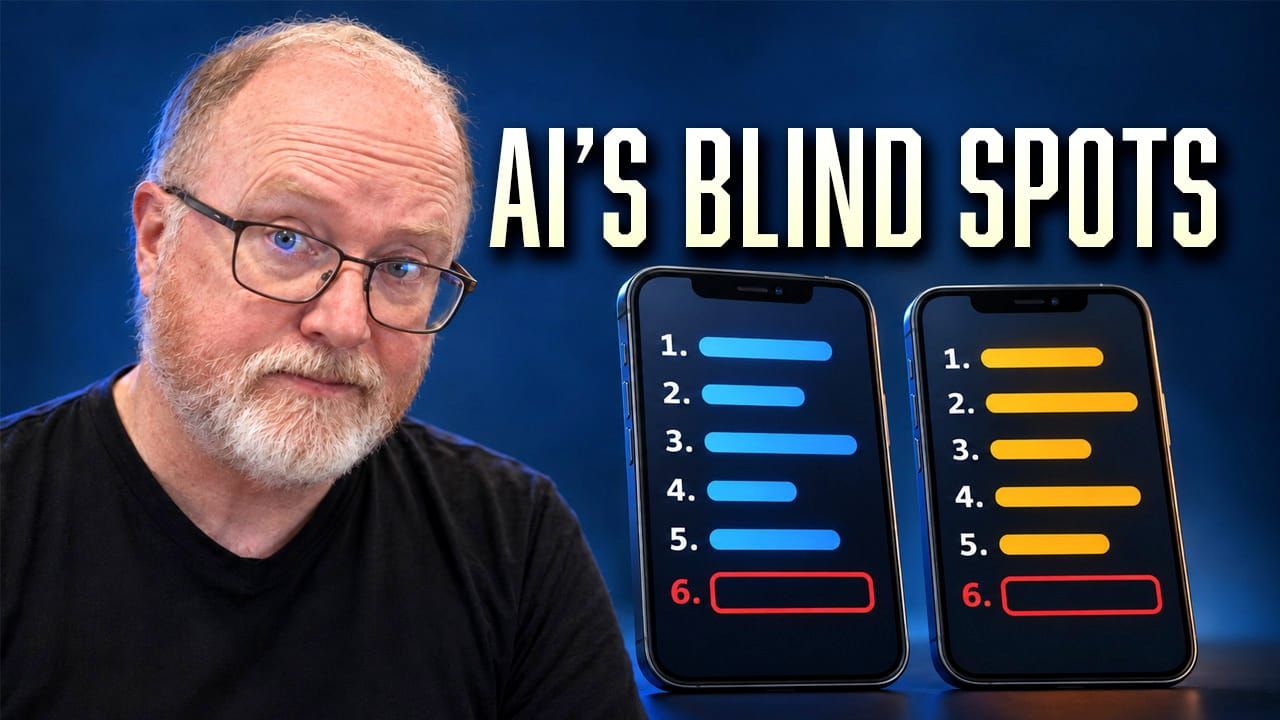
I asked two AIs one question, and both missed their own future. That's a critical thinking problem for anyone who uses AI.
I asked them:
"Take a look at consumer electronics and identify the top five unsolved problems that could become disruptions if a solution could be found."
Here's what came back. Grok saw problems to fix, like phones built so you can't repair them. Claude saw opportunities to build, like AR glasses you'd wear all day.
Same question, two different ways of seeing the industry, and each one read like the final answer.
With AI, critical thinking comes down to three checks. And later, I'll have one of these AIs argue against my own pick. It landed a couple of punches.
Let's get into it.
Check 1: Cross-Check With a Second AI
In my first video on critical thinking skills, one of the first steps was to cross-reference your sources. It still works. With AI, you cross-reference by asking a second AI the same question. Then read the two answers three ways.
Where they overlap, you have a stronger signal. Battery was number one on both lists. That's the one I'd look at first.
Where they split, your judgment starts.
- Grok: repair, software that kills devices, heat that limits on-device AI, and devices that won't connect.
- Claude: AR glasses, health sensing, memory costs, and trust in always-on devices.
Both lists are defensible. Deciding which matters is your job.
What's missing from both is the blind spot. That's where your own experience counts most.
Here's what I'd have put on the list: agents that reliably act for you.
The unsolved part is trust-grade reliability. An agent that's usually right can't be handed your money or your calendar. Solve that, and you stop opening apps. The agent does it for you, and the app store loses its cut.
Two AIs, asked for the next big disruption, and both missed AI agents. Not very self-aware.
That's a bigger deal than it sounds. In the early days, AI made things up. Fake sources. Fake people. Quotes nobody ever said. I learned to ask: what else is it making up?
Today's models make up far less. The new problem is harder to spot. You get one confident answer to a question that has many good answers. It sounds finished, so you stop looking.
That moment has a name. I call it mindjacking.
This is the first in a series on thinking clearly in the age of AI. If that's useful, subscribe so you catch the next one.
Innovation Newsletter from Phil McKinney
Four decades of experience. Delivered to your inbox.
Free or paid — your choice.
Check 2: Find the Hidden Assumptions
In my first video, this was questioning assumptions. With AI, every answer starts from an assumption it doesn't tell you about.
Grok's was right there in its first lines:
"Consumer electronics is not short of features. It is short of physics and incentives."
Everything after that was about what's broken. Claude started from what's next to build.
You only find the hidden assumption if you ask. So after any answer that matters, paste this in:
"What assumptions did you make? Now answer from the opposite starting point."
So I did, and Grok rethought its whole answer. Its first line:
"The last answer assumed the user's pain was the industry's unsolved problem."
Then it listed what it had taken for granted. That people want phones they can repair. That upgrading every two or three years is a design failure, when it's what people keep paying for.
Flipped, it gave me a different list:
- Getting a new device onto the shelf.
- A reason to switch when your photos and accounts live somewhere else.
- Who pays for the AI.
Most of it wasn't on either list. And look what still isn't there. Agents.
Your own assumptions count too, because the way you ask carries them. State an opinion and AI tends to lean your way. So ask, don't tell. "What are the risks of launching in March?" gets you more than "We should launch in March, right?"
That prompt, and the others in this episode, are in a free checklist with a worksheet. Download it below.
Check 3: Separate Evidence From Opinion
In my first video, this was applying logic and avoiding fallacies. AI adds a new fallacy: clear, confident writing feels like clear, confident reasoning.
Grok gave me repair grades, e-waste tonnage, and a compliance rate, with no sources attached. They read like facts. I checked. They held up. That time.
Today's models make up far less, but far less isn't never. When an AI gives you a fact, a number, or a quote you plan to repeat, check it first.
The first time, Grok was sure repair was the problem. The second time, it said sealed, "it just works" devices win "in every mass market that has been offered both."
Every market. Same AI, opposite answer, same certainty. How sure it sounds tells you nothing about whether it's right.
Some answers will tell you where the evidence ends. Claude labeled its fifth item:
"This is my own judgment rather than something the sources rank."
Grok's answer never separated fact from opinion. When it matters, ask:
Which of this is evidence, and which is your judgment?
And give it permission to disagree. I use AI every day, and I tell it: be brutally honest. It's amazing how much that changes the feedback, the analysis, and the suggestions. Blunt still isn't the same as right, so ask for its reasons too.
The AI Argues Back
The practice exercise in my first video was a debate. Flip a coin, argue the side you're given, then switch. With AI, you can run that debate against your own best idea. So I told Grok:
"I think the biggest unsolved problem in consumer electronics is agents that reliably act for you: trust-grade reliability. Argue as hard as you can that I'm wrong."
It came back swinging. It opened with:
"The claim confuses a software failure with a hardware industry."
It landed two good punches, and I'll give it both.
Humane's AI Pin and the Rabbit R1 struggled because the devices weren't good enough, not because people didn't trust the agent. Its line: "Trust does not fix a device with no job."
And sending money, emailing your lawyer, actions you can't undo: it called those the hard part. That's exactly what I mean by trust-grade. It made my case for me.
But look at what its whole argument rests on. It decided consumer electronics means devices. Just the objects. I meant the industry, including the software and services that decide what those devices are worth. Same two words, different definitions, and it never told me which one it was using.
That's a hidden assumption too, about what my words meant. Before you trust an answer, make sure you and the AI mean the same thing by the words.
Try This Today
AI is good at the legwork: gathering, listing, arguing the other side. The judging is still your job.
Pick an industry you know and ask two different AIs for the top five unsolved problems. Then:
- Cross-check. Compare where the lists overlap, where they split, and what both missed.
- Find the hidden assumptions. Ask what it assumed, then have it answer from the opposite starting point.
- Separate evidence from opinion. Check any fact you plan to repeat, and ask which parts are its judgment.
- Make it argue against your favorite. "I think [your position]. Argue as hard as you can that I'm wrong."
That moment when you stop looking, because the answer sounds finished, is mindjacking. It's what my next book is about.
So tell me in the comments: what showed up on one list and not the other?
Go deeper: How To Improve Your Critical Thinking Skills