
The Innovation Fatigue Crisis: Why Your Best Ideas Are Getting Ignored
Your best innovation ideas aren't losing to bad ideas – they're losing to exhaustion. Intelligence doesn't predict innovation success. Attention allocation does.

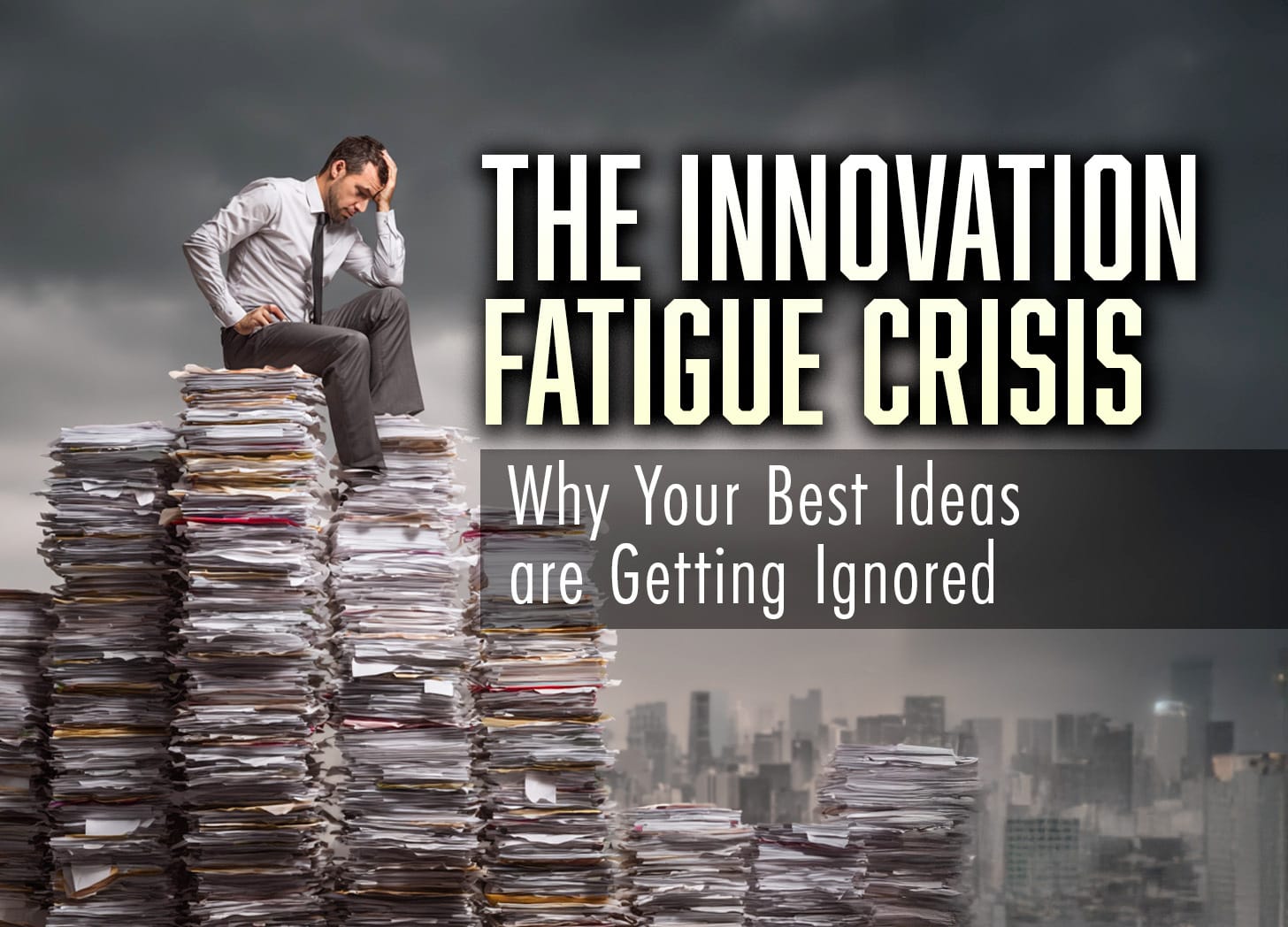
After decades making billion-dollar innovation decisions at HP and CableLabs, I'm watching a crisis I first recognized in my own organization spread everywhere: genuinely breakthrough ideas dying not from poor evaluation, but from attention scarcity. We've created an innovation economy that's too innovative to innovate.
The hidden epidemic killing breakthrough thinking right now isn't lack of creativity or resources – it's the overwhelming flood of "revolutionary" opportunities that's drowning out actual revolutions. Every executive I know is building cognitive defenses just to survive their daily pitch parade.
Today I'll reveal why even brilliant ideas are getting ignored, and what this attention crisis means for leaders trying to drive breakthrough innovation today.
The Attention Economy Meets Innovation Overload
We're living through an unprecedented moment: every executive is drowning in innovation pitches, AI promises, and "game-changing" opportunities. Every C-suite leader I know is evaluating 40+ innovation proposals monthly – that's what they tell me when I ask why good ideas are getting ignored. That's two per business day, every day, without break.
The psychology has shifted dramatically. Decision-makers are developing reflexive skepticism toward all innovation claims as a survival mechanism. It's not cynicism – it's cognitive self-defense against proposal overload.
In conversations with dozens of executives over the past year, nearly three-quarters tell me "innovation fatigue" has become their top decision challenge. Good ideas are dying not from merit evaluation but from attention competition. The irony is staggering – we've created an innovation economy where the sheer volume of innovation prevents actual innovation from breaking through.
Consider the irony: I'm using the same overloaded language ("revolutionary," "game-changing") that's part of the problem. When every idea is described as transformational, the words lose all meaning.
Last month alone, I was pitched 23 "revolutionary" AI solutions. Most were actually solid ideas with real potential. But none got the attention they deserved because my brain had already tagged them as "more innovation noise" before I could properly evaluate their merit.
The cruel mathematics are simple: paradigm-shifting concepts need deep consideration, but executives only have bandwidth for surface-level evaluation of the flood hitting their desk.
Case Study: HP's Innovation Program Office and the Haystack Problem
Let me tell you about where I first discovered this crisis – when I was running HP's Innovation Program Office (IPO).
The IPO was HP's dedicated engine for identifying, incubating, and launching transformational technologies that would become the company's future growth drivers. We had established frameworks, secured funding, and built what everyone considered a world-class innovation process. Harvard and Stanford now teach case studies about our approach.
But here's what those case studies didn't capture: we were drowning.
More than a decade ago, the HP Innovation Program Office received more than 3,000 ideas and pitches every year. Think about that number for a moment. That's nearly 60 new innovation opportunities hitting our desk every week. Each one claiming to be game-changing. Each one demanding evaluation. Each one potentially containing the next billion-dollar opportunity for HP.
No team – no matter how smart, no matter how well-resourced – can properly evaluate 3,000 innovation ideas annually. The mathematics are impossible. And that number keeps going up.
Fatigue became our constant battle. The pipeline of new pitches and raw ideas never got smaller, no matter how many we processed. We would clear 50 proposals one week, only to find 65 new ones waiting the next. It felt like trying to empty an ocean with a bucket.
We built tools. We created frameworks. We established selection criteria. We hired brilliant people and trained them extensively. But underneath all our sophisticated processes was a gnawing feeling that haunted every decision: somewhere in those 3,000 ideas were genuine breakthroughs that we weren't giving proper attention.
The needle-in-the-haystack problem became our existential crisis. How do you find the truly revolutionary ideas when you're buried under an avalanche of merely good ones? How do you maintain the cognitive energy to recognize brilliance when you're processing dozens of "game-changing" proposals every week?
I remember one particularly brutal month where we evaluated around 250 innovation pitches. By week three, I caught myself skimming proposals that deserved hours of consideration. By week four, I was unconsciously looking for reasons to say no rather than reasons to say yes. That's when I realized the system had broken me – and if it could break someone whose job was literally to find paradigm-shifting innovation, it was breaking everyone.
The most painful part? Years later, I would occasionally encounter innovations in the market that looked suspiciously familiar. Ideas that had been buried in our pipeline, dismissed not because they lacked merit, but because they arrived during a week when we were too overwhelmed to give them the attention they deserved.
We had built the most sophisticated innovation evaluation process in corporate America, and it was systematically filtering out the very breakthroughs it was designed to find. Not because our frameworks were wrong, but because human attention has limits that no framework can overcome.
That's when I realized we had an attention problem, not an innovation problem.
That HP experience taught me to recognize the pattern. Since then, I've worked with dozens of companies facing the same crisis. The scale varies – some see 500 pitches annually, others see 5,000 – but the attention mathematics always break the same way.
I thought this was just an HP problem until I started advising Fortune 500 companies and governments. At every organization, I found the same pattern: innovation teams drowning in opportunity abundance, executives developing decision fatigue, and transformational ideas dying from attention scarcity rather than merit evaluation.
"Intelligence doesn't predict innovation success. Attention allocation does."
The Three Types of Innovation Fatigue
Through analyzing the HP experience and dozens of similar failures across multiple organizations, I've identified three distinct types of innovation fatigue destroying breakthrough potential:
Type 1: Executive Innovation Fatigue
The Symptom: Senior leaders developing reflexive skepticism toward all innovation pitches, regardless of merit.
The Cause: The overpromise/underdeliver cycle has trained executives to expect disappointment from innovation investments. After being burned by "revolutionary" solutions that delivered incremental improvements, leaders develop cognitive antibodies against innovation enthusiasm.
The Impact: Even legitimate breakthroughs get dismissed as "more innovation theater" before receiving proper evaluation.
I recently spoke with a Fortune 500 CEO who instituted a company-wide moratorium: "No more innovation pitch meetings for six months. We're drowning in paradigm-shifting promises and starving for actual execution." This wasn't anti-innovation leadership – this was a smart executive recognizing that innovation overload was preventing innovation success.
Type 2: Team Innovation Fatigue
The Symptom: Innovation teams burning out from launching initiatives that consistently get killed or ignored during the evaluation process.
The Cause: Organizations creating continuous innovation pressure without building the decision infrastructure to properly evaluate and support transformational ideas.
The Impact: The best innovators leave for companies with clearer innovation mandates and better decision-making processes.
At HP's IPO, I watched our most creative evaluators essentially stop fighting for genuinely novel solutions. When I asked why, one told me, "When you're processing 60 pitches a week, you learn to spot the safe bets quickly. Fighting for the truly revolutionary ones takes energy I don't have anymore."
This is innovation death by a thousand small compromises.
Type 3: Market Innovation Fatigue
The Symptom: Customers and investors becoming numb to innovation claims, treating all "paradigm-shifting" announcements with equal skepticism.
The Cause: "Revolutionary" has lost all meaning through overuse. Every product launch, every startup pitch, every feature update is positioned as game-changing innovation.
The Impact: Actual breakthroughs struggle to differentiate from incremental improvements because the market has developed immunity to innovation language.
Consider how "AI-powered" became the new "cloud-enabled" – meaningless marketing speak that signals nothing about actual innovation value. When everything is revolutionary, nothing is revolutionary.
Why This Crisis Is Different (and Dangerous)
This isn't just another innovation challenge we can solve with better processes or more resources. This crisis is fundamentally different from anything we've faced before.
Historically, innovation slowdowns were resource problems. Companies couldn't innovate because they lacked money, talent, or technology. The solution was always to invest more resources in innovation capability.
Today's crisis is an attention and focus scarcity problem in an abundance economy. We have unlimited innovation opportunities and limited cognitive bandwidth to evaluate them properly. More resources won't solve attention mathematics.
The danger is that we're not innovation-starved – we're innovation-overwhelmed.
Transformational opportunities are getting lost in the noise of marginal improvements, and the companies that figure out attention allocation will dominate the next decade while everyone else drowns in their own innovation success.
This isn't about having better ideas. It's about being heard above the innovation noise, and most organizations have no systematic approach to cutting through their own opportunity abundance.
The most dangerous phrase in innovation isn't 'that will never work' – it's 'we'll review this later.’
What This Means for Your Innovation Strategy
Innovation fatigue represents both the biggest threat and the biggest opportunity facing leaders today. The companies that solve attention allocation – both internally and in the market – will capture disproportionate value while their competitors remain paralyzed by choice abundance.
But here's what keeps me awake at night: innovation fatigue is just one of ten critical innovation decision challenges that nobody's addressing directly. Over the past month, I've identified the unspoken problems that determine whether billion-dollar innovation bets succeed or fail – and most leaders don't even recognize they exist.
These aren't the usual "innovation best practices" you'll find in Harvard Business Review. These are the hard truths about why smart people consistently make terrible choices about genuinely novel ideas, based on three decades of watching brilliant executives destroy brilliant innovations through decision-making errors that could be avoided.
Next week, I want you to choose which innovation decision challenge I decode first. I've seen these patterns destroy more transformational potential than market failures, technical problems, and resource constraints combined.
Help me choose the innovation decision challenge that's most urgent for you right now.
The companies that master innovation decisions while their competitors remain overwhelmed by innovation opportunities will write the next chapter of business history.
Which chapter will your company write?
What innovation decision challenges are you seeing in your organization? Reply and let me know – your insights often reveal patterns I haven't considered.