Everyone Bought the Same AI. Nobody Bought an Advantage.
Why AI can't give you a competitive edge, and what still can.

How many times has a salesperson or consultant put up the proof slide? You know the one. Every logo of every customer they've served. We've all sat through it.
How many times did those logos close the deal?
Now think back. How many of those logos were your competitors? Or the ones just starting to circle your market?
They bought what you're about to buy. And you'll look, feel, taste, and smell just like them. Bring in the consultant who works for your competitors, and you're not adopting "best practices." You're adopting your competitors' practices.
AI is the same slide. Only now it's hidden. You never see the logos, but they're there. Every frontier model learned from nearly the same library: everything on the internet. Let it do the driving, and you're buying exactly what everyone else bought.
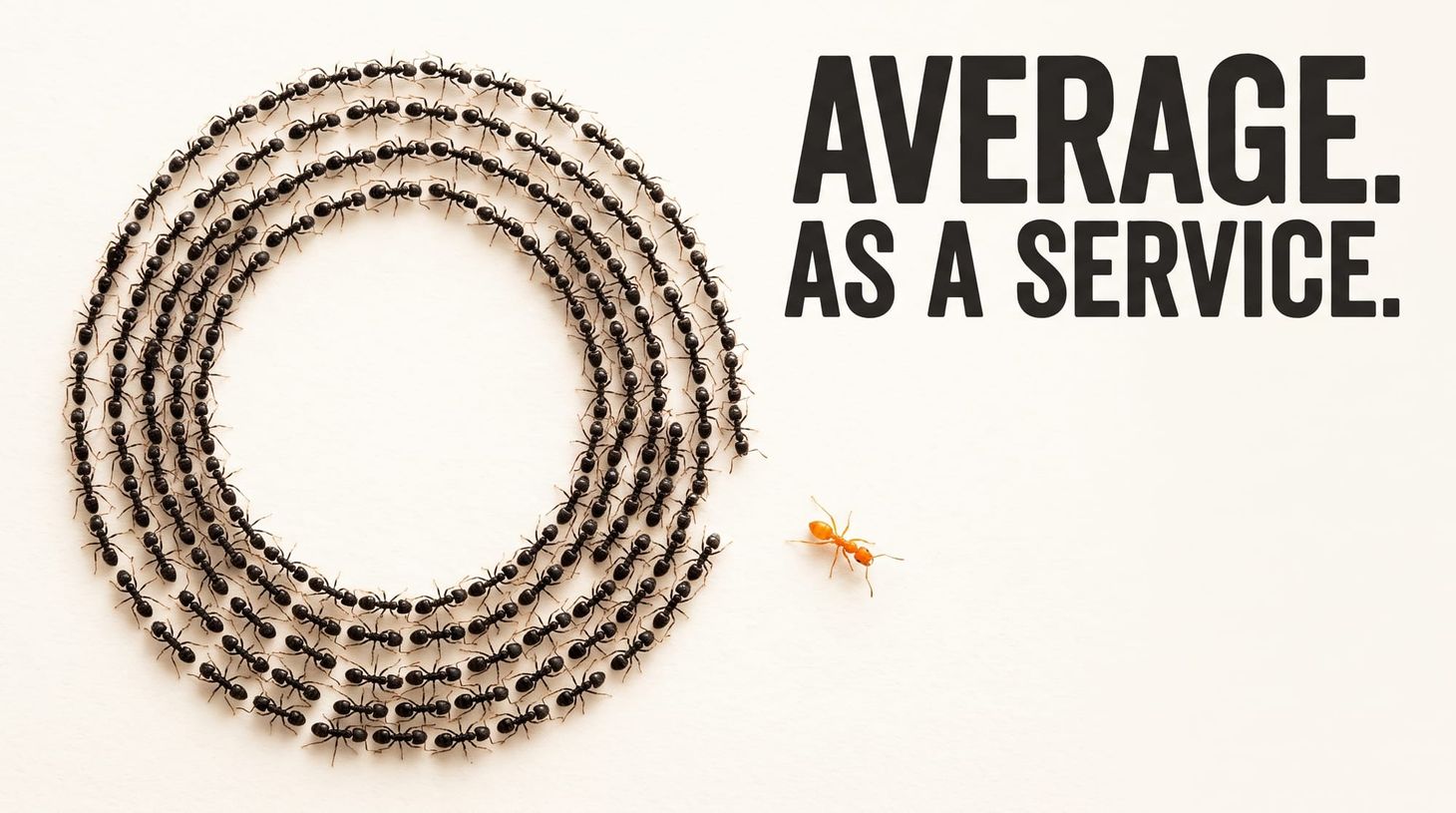
Average. As a service.
The advisor everyone hired
You hand it the problem. The answer comes back so polished, so sure of itself, that it feels like you're talking to a senior advisor with deep experience.
You're not. You're getting the collective experience of the entire internet. And so are your competitors.
Imagine one advisor for the entire world, giving the same advice to every company and every leader. The world would turn average. That's no longer a thought experiment. It's the subscription your whole industry just signed up for.
We've been here before with the big-name consulting houses. McKinsey has a fairly focused playbook. I've watched them walk into completely different organizations with similar problems and deliver the same answer. Problem A gets answer number three. It may be the safe answer. It won't let you lead your market. It pulls you to the middle. Vanilla.
AI does the same thing, faster, and without the logo slide.
Why the same answer? These models predict the next most likely word, based on what they were trained on. Think of the colleague whose presentations you've sat through a hundred times: you can finish her sentences. Spend enough time with an AI model and you can finish its sentences too. So the answer you get is the consensus of what's already been written. Not necessarily wrong. Just everyone else's answer too.
You can spot AI's work two slides in. Overly positive. Confident and authoritative, with no real experience behind it. And everything is three bullet points.
The research says the same thing. When Harvard and Boston Consulting Group gave AI to 758 consultants, the weaker performers improved 43 percent and the top performers 17 percent. Great for the bottom of the curve. Not much of an edge at the top.
I know what's in it
I know what these models were built from. Books like mine. For years, I'd get notified two, three, four times a month that Beyond the Obvious was being sold illegally somewhere: Russia, South America, Eastern Europe, the U.S. At some point you throw your hands up. So when the news broke that it was one of more than seven million pirated books an AI company had downloaded, I wasn't as upset as people might think. It's on the list of works covered by Anthropic's $1.5 billion settlement with authors.
Here's the irony. That book was about not doing what the crowd does. Don't stop at the first answer. Push past the obvious, because that's where competitive advantage comes from.
Now it's an ingredient in a machine that produces the obvious, available to every one of your competitors, in the same answer. That's what happens to an edge when everyone gets it.
It used to take effort. You read the books, did the research, wrestled it into your own thinking. Now we all go to AI and get the same answer.
Never miss a post from Studio Notes
Get innovation decision insights delivered to your inbox. Free or paid — your choice.
The ant mill
There's a story I tell on stage about what happens when everyone plays follow the leader. It's about army ants.
One ant heads out looking for food and lays down a trail of pheromones. The next ant follows it. The next follows that one. We've all seen the line snake across a sidewalk.
Every so often, the lead ant circles back and picks up the scent of the line behind it. It does what it's programmed to do: it stops searching and falls in. Now the line is a circle. An ant mill. They march around and around until they die, perfectly obeying their programming to follow the ant in front.
The mills that survive have a broken ant. One that doesn't follow the rule. It steps out, the ant behind it follows, the mill breaks apart, and the colony lives.
Best practices are the ant in front. So is the software stack. So is the answer every one of your competitors got from the same AI model this morning.
Which are you? The programmed ant, following the consultant or the AI? Or the broken ant?
Written off
Here's what a broken ant looks like in practice.
When I got to HP, right after the Compaq merger, the PC business was losing money. The conventional wisdom was settled: PCs were a commodity. Everybody runs Windows, everybody runs Intel, everybody builds the same box. The whole industry was following the ant in front. At HP, there were rumors about shutting the PC division down.
A handful of us came in with a different perspective. Satjiv Chahil, who'd run marketing at Apple, myself, and a few others shared one belief: there's always room to innovate. So we started with the person who matters most: the customer.
If someone asked to borrow your laptop, would you give it to them? It has your browser history. Your photos. Your finances. Our research kept showing the same thing: people were more likely to hand over their wallet than their laptop. A laptop isn't a commodity. It's personal.
That became "The Computer Is Personal Again." It drove the advertising, and it drove the technology: privacy and security, which still show up in HP's products today. It drove design, with name designers on laptops and musicians on sound.
Did we get pushback? You bet. It's expensive. So how do you pay for it? You can't cut your way to a turnaround. Cost discipline was table stakes. The money came from reallocating toward innovation. That became HP's Innovation Program Office.
The PC business went from a $372 million operating loss in 2002 to $2.4 billion in operating profit by 2008, more than a third of HP's revenue. In 2006 it became the number-one PC maker in the world. In a market everyone had written off as a commodity.
Where average is fine, and where it's fatal
None of this is an argument against AI. Skip it and you'll lose on speed.
Average is fine for trip reports, expense reports, and policy documents. Let AI do them. It's why you hire a lawyer who has already written a hundred contracts like yours.
Average is fatal when you use AI for your strategy, your product, your story, and expect a different outcome. Most find out too late that they got the same answer their competitors got.
That's why the headlines about companies laying off thousands of people for "AI efficiency" worry me. AI is accelerating your move to the middle, not your differentiation. And the people you're letting go may be your broken ants.
So how do you stand out? It's your people.
The human part is divergent thinking: a ton of ideas nobody else would think of, connecting random dots AI would never connect. AI is a great partner for convergent thinking: researching, comparing, narrowing the pile down to what matters. You lead. It follows. Flip that, and even your best people get pulled down to the average.
And if you're the one worried AI is coming for your job: this is your opening. Bring your full self. Your ingenuity, your creativity, your empathy for customers. Everybody is born creative. It may have been beaten out of you along the way, but it's there. Before you ask AI for ideas, write down five of your own.
Think first
So what would I tell a leader on Monday morning, before anyone types a prompt? Understand the problem before you go looking for the answer. AI makes jumping to the answer instant. It can't understand your customer for you.
For years at HP, I spent most Saturdays at places like Best Buy watching and talking to our customers. When someone picked up an HP product, put it down, and bought a competitor's, I'd hand them my card. It usually freaked them out that HP's CTO was stalking them in the aisle. Then I'd ask: what was going on in your head?
You are not a proxy for your customer. The needs that matter are the ones customers can't put into words, because they don't know what's possible. You have to go see them. No model can do that for you.
This week, before you ask AI anything, spend an hour with one customer. Watch. Ask what was going on in their head.
Use the same tools the way everyone else does, and you've paid for average as a service.
Be the broken ant. The other ants will follow.
Do you agree? Disagree? What are you doing to stand out with your own ingenuity and creativity, using AI's tools rather than letting them be the answer?