I'm Too Good at Keeping Busy. So Are You.
A confession about deep work, deferred priorities, and the three tripwires I built when I stopped trusting myself.

Paid subscribers are reading early Mindjacking chapters right now. They also get the full archive, the Creating Killer Innovations audio course, Studio Live access, and a free copy of Mindjacking when it ships in late 2026.
Become a paid subscriber →I've been writing a book for two years. Most weeks, I don't work on it. The problem isn't time. I have time. The problem is that I keep spending it on things that feel like progress and aren't.
I'm Too Good at Being Busy
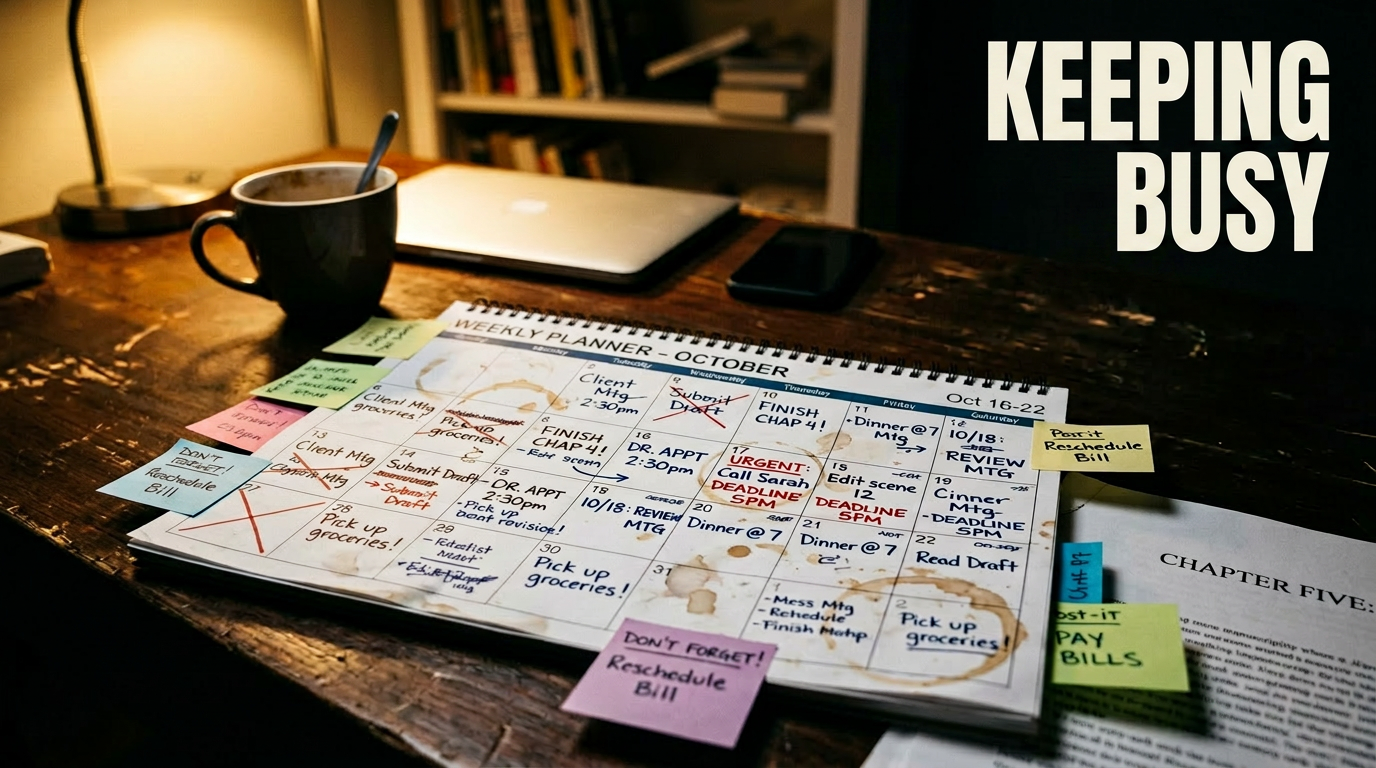
I'm not bad at being busy. I'm way too good at it. What I'm bad at is protecting the slow, deep work. The kind of thinking that takes hours, not minutes. The kind that doesn't show up the moment you sit down because you have to give it time to get going. Most of what fills my calendar doesn't need that. A status meeting doesn't need that. An email reply doesn't need that. A quick decision someone needs from me doesn't need that. But the work that actually matters does, and that's the kind of time my calendar never seems to have. I've been doing the easier things for a long time.
But not entirely. I've known about this pattern for years. I drift in the moment, and over time I've built tripwires to catch myself.
Three Tripwires I've Set for Myself
A tripwire is an action I run on myself to catch when I'm drifting. Here are the three I rely on most.
The Sunday list test. On Sunday evening I look at the week ahead and ask one question. If I finished it, which item on this list would actually matter a month from now? Most weeks one or two things pass that test. Sometimes none of them do. When none of them do, the list is wrong. That doesn't mean I cancel everything. It means I've been letting the urgent crowd out the important, and I need to fix it before Monday morning makes the decision for me.
The leftovers question. Not what I did this week. What kept getting pushed. The item that keeps sliding from Monday to Tuesday to Wednesday to "I'll get to it next week" is almost always the one that matters most. Easy things finish. Important things wait. If the same item has been sliding for three weeks, that's not a scheduling problem. That's a signal.
The fast yes. When I say yes to something inside of about ten seconds, I'm not really saying yes to that thing. I'm saying no to whatever I would have had to think about if I'd paused. I've started catching myself in the middle of a fast yes and forcing myself to wait until the next day to confirm. About a third of the time I come back the next day and say no. That third would have eaten my next quarter.
These tripwires don't run themselves. I forget to set them. I ignore them when they go off. I rationalize. The point isn't that I've solved anything. The point is that when I'm honest with myself, I have enough evidence about my own patterns to know what's happening, even when in the moment it feels like the choices are reasonable.
So what have the tripwires been telling me lately? The slow work has been in the leftovers column for months. Not occasionally. Consistently. The list test has been failing more weeks than it's been passing. And I've been saying fast yes to things that produce visible output, because visible output is satisfying and a half-finished chapter in a draft folder is not. The tripwires have been going off. I've been hearing them. I just hadn't done anything about it.
Now I am.
If this is landing for you — paid subscribers are reading early Mindjacking chapters as they're written, plus the full archive, the Creating Killer Innovations audio course, and a free copy of Mindjacking when it ships in October.
Upgrade to paid →Studio Sessions Weekly. Studio Notes When It Matters.
Starting May 27, Studio Sessions becomes the one weekly thing I publish. If you're new here, that's the long-form piece I put out in three formats: read it, listen to it, or watch it. Your choice. Studio Notes, the Monday news take, isn't going away. It's shifting to when something happens in the world that's worth a take. When a board makes a call worth examining, when a leader does something genuinely smart or genuinely not, you'll get a Note. But not on a schedule. Only when there's something real to say. The bad calls aren't hard to find. The good ones are getting harder, which tells you something about where we are.
Three Changes to the Book
Once I started giving my next book the time it actually needed, three things became obvious. Each of them is a change I should have made months ago.
The title is changing. Thinking Independence is becoming Mindjacking. Mindjacking was a word I'd been using inside the chapters to name what happens when you hand your thinking over to someone else. An early reader spotted it and asked why it wasn't the title. The moment they did, I knew it was right. Thinking Independence describes a goal. Mindjacking describes what's happening to us. One is the destination. The other is the thing we have to see before the destination matters. I wanted the old title. The book needed the new one.
The structure is changing too. This came from paid subscribers reading the early chapters and telling me, in different ways, what was and wasn't working. I'm not going to describe the new shape, and I want to be honest about why. Part of how the book works is that the reader experiences the structure rather than has it explained to them. If I tell you what's coming, I take that away. You'll see it when you read it. I think you'll feel the difference inside the first few pages.
The audience is also changing, and this one I went back and forth on for months. I started writing this book for executives and innovation leaders, because that's who I've spent my career talking to. But sixty-one percent of the people reading the early chapters told us they recognized themselves in the opening pages, and most of them weren't executives. They were teachers. Tradespeople. Parents. Retirees. Students. People who had never thought of themselves as having a thinking problem until the first few pages showed them one. The book they were reading was for everyone. The book I was telling people I was writing was for executives. Those two things couldn't both be true.
So the book is for all of us now. Because what the book describes is happening to all of us. It happens to me. It happened in rooms I used to run. That's not a marketing pivot. It's the book finally being honest about who it's for.
What isn't changing: the publication target is still Q4 2026, still self-published, still under 20,000 words, still designed to be read in one sitting. The early chapters will keep going out to paid subscribers as they're ready. The work continues. It just has more room now.
If you're a paid subscriber, thank you. Your feedback is the reason the book is getting better instead of just getting longer. If you're reading for free, thank you for being here. And if the new rhythm doesn't work for you, I understand.
— Phil
Enter the Studio
Free
Studio Sessions every Wednesday — delivered to your inbox. Plus Studio Notes when news warrants it.
Subscribe FreePaid — $50/year
Everything in Free, plus:
- Early Mindjacking chapters as they're written (paid subscribers only)
- Free digital copy of Mindjacking when it ships (late 2026)
- Free digital copy of every future book
- Full archive (decades of writing)
- Creating Killer Innovations audio course
- Studio Live monthly sessions
Founders — $350/year
Limited to 50 subscribers. Founders cohort closes when Mindjacking ships.
Everything in Paid, plus:
- Direct email access to Phil
- Twice-yearly 1:1 calls
- Founders-only Studio Live sessions
- Signed first editions of books