
The 50-Year Overnight Success: What Dr Bose Taught Me About Innovation Patience
How deliberately slowing down in a world obsessed with speed transformed my approach to breakthrough innovation decisions

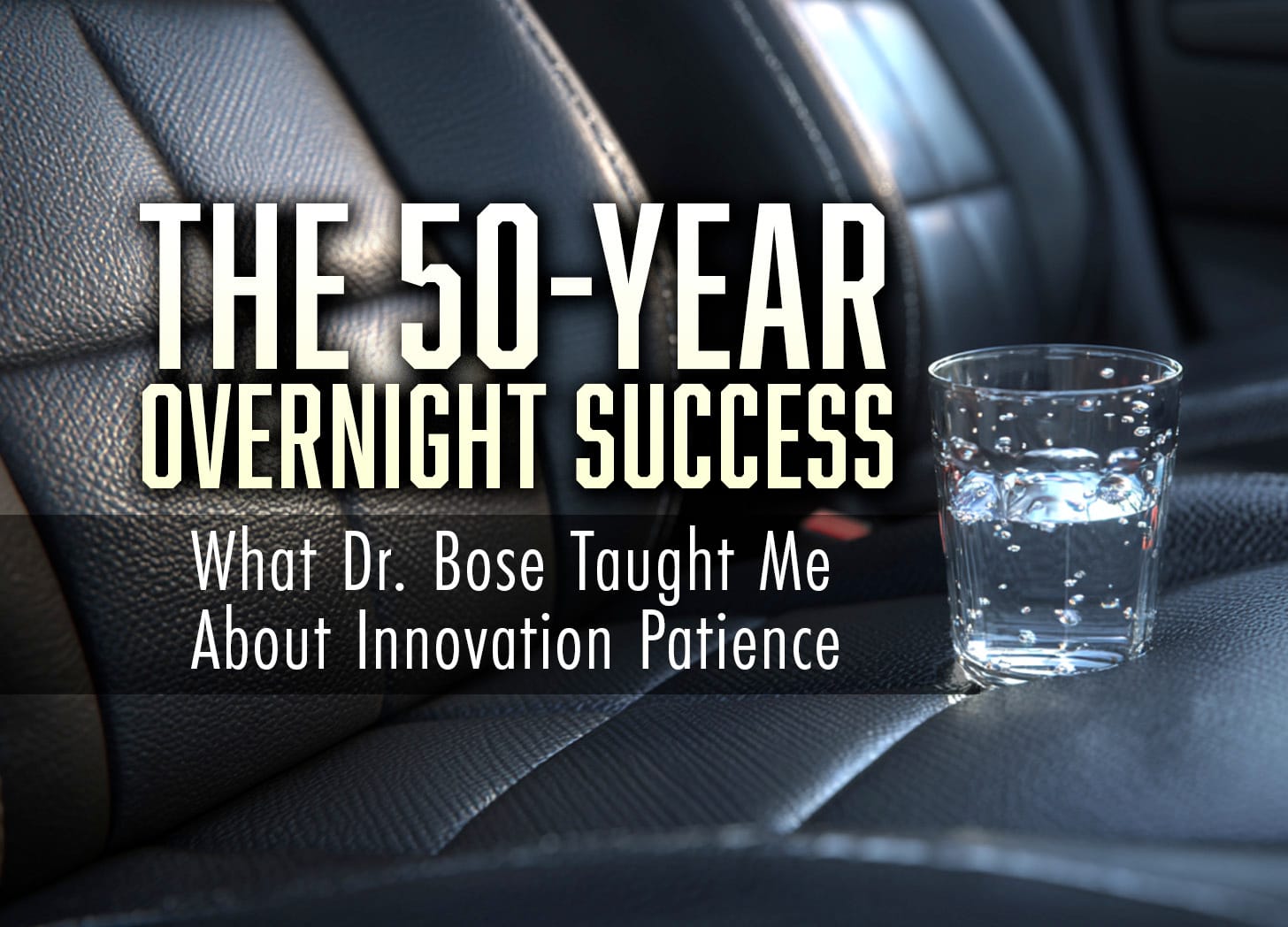
Most innovation advice tells you to fail fast. I learned the opposite from watching a glass of water sit perfectly still while a car bounced violently beneath it.
The demonstration happened in Dr. Amar Bose's lab at Bose Corporation headquarters around 2006. What I witnessed wasn't just a technology demo—it was a masterclass in patient innovation that would fundamentally rewire my approach to transformative thinking after decades of Fortune 100 decision-making.
There's a moment in every innovation leader's career when the math says something will work, but the world isn't ready for it. For Dr. Bose—founder of Bose Corporation¹—that moment came in the 1960s when he developed an elegant mathematical model for a revolutionary car suspension system. The technology to build it didn't exist yet. Most executives would have killed the project.
Dr. Bose didn't. He waited. For fifty years.² His commitment to long-term thinking over short-term returns ran so deep that in 2011, he donated a majority of Bose Corporation to MIT in the form of non-voting shares³—choosing to fund future research over immediate financial gain.
The Water Glass That Rewrote My Innovation Playbook
The Bose suspension system looked deceptively simple in that Cambridge lab—a regular car seat mounted on what appeared to be standard automotive hardware. But when Dr. Bose activated the system and had his assistant drive over increasingly aggressive road obstacles, something extraordinary happened.
The car chassis bounced violently. The seat remained perfectly still.
"Watch this," Dr. Bose said, placing a full glass of water on the seat. The assistant drove over a speed bump at 30 mph. The chassis lurched. The water didn't spill a drop.
When I asked Dr. Bose how he could possibly invest in an idea for fifty years, he explained that Bose being private meant they weren't caught in the quarterly results pressure that destroys patient innovation at public companies.
As HP's CTO, I thought I understood technology development timelines. I'd made billion-dollar innovation decisions, managed global R&D portfolios, and prided myself on speed-to-market excellence. Sitting in that lab, listening to Dr. Bose explain the journey from 1960s mathematical model to working prototype, I realized I'd been thinking about innovation all wrong.
"The companies who master patient innovation don't just create better products—they create sustainable competitive advantages that rapid iteration cannot replicate."
This wasn't just another R&D project. This was a systematic approach to transformative innovation that most Fortune 100 companies—including my own—had systematically dismantled in favor of quarterly thinking.
Studio Notes: Innovation Decisions is a reader-supported publication. To receive new posts and support my work, consider becoming a free or paid subscriber.
How Quarterly Thinking Killed My Innovation Pipeline
Walking out of Dr. Bose's lab, I started questioning everything about HP's innovation approach. We were optimizing for velocity when we should have been optimizing for breakthrough potential under uncertainty.
Back at HP, I began asking different questions:
- Instead of "How quickly can we bring this to market?" I asked "What fundamental enabling technologies must mature before this becomes commercially viable?"
- Instead of "What's our quarterly R&D burn rate?" I asked "What's the breakthrough potential if we solve this correctly?"
- Instead of "Why hasn't this shown results yet?" I asked "Does the mathematics work, and what ecosystem enablers need time to develop?"
The shift revealed a disturbing pattern. They were killing promising fundamental research the moment it didn't produce immediate commercial results. They'd become innovation sprinters in a marathon game.
The HP Examples
I witnessed this firsthand during my time at HP. We acquired Palm and its revolutionary WebOS in 2010 for $1.2 billion⁴, then killed it when it didn't achieve immediate market dominance.
We pioneered digital camera technology⁵, then abandoned it when smartphones began incorporating cameras.
Most painfully, we developed HP Halo—immersive telepresence rooms that delivered extraordinary meeting experiences—then sold the technology to Polycom for $89 million in 2011⁶ when quarterly pressures demanded focus. The irony? HP bought Poly for $3.3 billion in 2022⁷, essentially paying 37 times more to reacquire capabilities built on our own patient innovation after recognizing its long-term value.
What was really happening: As a public company, HP lived and died by quarterly earnings calls. Every ninety days, they had to show growth. That quarterly drumbeat made them kill anything that couldn't produce results fast—exactly the trap Dr. Bose had warned me about. They weren't bad managers. They were following exactly the kind of thinking that "fail fast" promotes under quarterly pressure.
The Dell Example
Through my relationship with Alex Mandl⁸—my former boss at Teligent who led the board negotiations to take Dell private—I witnessed the most compelling modern example. Michael Dell and Silver Lake paid $24.9 billion⁹ for one thing—freedom from the quarterly earnings pressure that was killing their long-term potential. Dell explicitly stated the goal was "no more pulling R&D and growth investments to make in-quarter numbers." R&D spending increased from $1.1 billion to $4.4 billion¹⁰, transforming Dell from declining PC manufacturer to enterprise solutions leader. The result: an estimated $70 billion return by 2023¹¹.
The Mathematics of Patient Innovation
Dr. Bose's approach wasn't about throwing money at uncertain projects indefinitely. It was about recognizing when the mathematics work but the ecosystem isn't ready—and having the discipline to invest systematically until convergence occurs.
"He was patient," Jim Parison, the Distinguished Engineer who led development, explained in an interview with IdeaConnection. "If he believed that the math said it would work, he was prepared to wait to see if it would go."¹²
The suspension system exemplifies this perfectly. Dr. Bose's mathematical model from the 1960s was sound. The electromagnetic actuators powerful enough to counteract road forces didn't exist. The power amplification technology was too bulky. The control systems weren't sophisticated enough. Each component required independent technological advancement before the system could work commercially.
Through years of analyzing what worked and what failed, I've identified five critical elements that help determine when an idea deserves patience instead of being killed early. Each element builds on the others. Miss one, and you might waste years on a project that will never work. Recognize all five, and you've found something worth protecting from the "fail fast" mentality.
[For a detailed walkthrough of how to apply these five elements to your current projects, check out my companion video "Why 'Fail Fast' Innovation Advice Is Wrong" releasing Wednesday.]
These became the patient capital elements of my Decision Thinking™ framework:
1. The Mathematics Validation: Does the fundamental science work?
Dr. Bose's suspension system passed this test in the 1960s. The mathematical model was elegant and sound. This isn't about having a business plan or market research—it's about verifying that the underlying physics, chemistry, or engineering principles are mathematically correct. Without this foundation, no amount of patience will create transformative innovation.
2. The Ecosystem Readiness Assessment: What technological enablers must mature before commercial viability?
For Bose: electromagnetic actuators with sufficient power density, compact amplification technology, and sophisticated real-time control systems. Map every technological dependency and assess their development timelines. Patient capital works when you can systematically advance each component, but fails when you're waiting for simultaneous advances across multiple unrelated fields.
3. The Market Evolution Analysis: When will compelling demand exist for the solution?
Take Bose—automotive applications existed in the 1960s, but initially it was about ride comfort for luxury cars. The real advance came when the market evolved. By the 2000s, truck driver health became urgent—preventing back injuries from constant vibration created compelling demand that justified the cost.
Corning (discussed below) shows a different type of market evolution. They started with automotive glass in the sixties, but the major development came when they pivoted to a completely different market—consumer electronics. The iPhone created demand they never could have predicted from their automotive starting point. Patient innovation requires understanding not just current market needs, but how problems will evolve or entirely new markets will emerge.
4. The Sustainable Advantage Evaluation: How long will the competitive moat last once achieved?
Dr. Bose's electromagnetic approach created defensible intellectual property around the entire system architecture—not just individual components but the integration methodology. Major advances should create technological moats that competitors cannot easily replicate through incremental improvement or faster iteration.
5. The Organizational Patience Capacity: Can the organization sustain investment through uncertain development cycles?
Private ownership gave Bose this capacity. Dr. Bose's decision to keep the company privately held created a corporate culture that could support patient innovation without quarterly earnings pressure destroying long-term projects. Most public companies lack the governance structures to protect long-term projects from quarterly pressures. This assessment determines whether patient capital is organizationally viable, regardless of technological merit.
Why Speed Kills Major Advances
In my regular conversations with Wendell Weeks¹³, Corning's Chairman and CEO, he has consistently reinforced how patient innovation mindset remains core to their strategy—balancing sustained investment in fundamental materials science with rapid application development as market opportunities emerge.
What makes Corning remarkable: They're a public company, founded in 1851, that went public in 1945¹⁴. They've managed to maintain patient innovation despite quarterly earnings calls. How? They established a culture of long-term thinking before the quarterly pressure system even existed. Initial ion-exchange strengthening technology emerged in 1962. By the 1960s, they'd developed "Chemcor" muscled glass for automotive applications¹⁵. The technology lay dormant until 2005, when consumer electronics created new demand. Apple's first iPhone in 2007 featured the revived technology, launching a product line now protecting 8 billion devices globally¹⁶.
The key insight: patient innovation creates technological moats that rapid iteration cannot replicate. Once Corning perfected Gorilla Glass, competitors couldn't simply iterate their way to equivalent performance. The fundamental materials science advance required sustained investment through uncertain development cycles.
The paradox that most people miss: patient innovation often produces faster competitive advantage once achieved. That's a 45-year development cycle that would have been killed dozens of times in today's quarterly-driven environment.
Building Your Innovation Portfolio for the Long Game
The most successful innovation leaders I know balance patient capital with rapid iteration through systematic portfolio allocation. Here's what actually works:
Portfolio Approach: I use the 70/20/10 model: 70% core improvements (incremental innovations), 20% adjacent markets or technologies, and 10% transformational breakthroughs that could change the game entirely.
Mathematics First: Before any patient capital investment, verify the fundamental science works. No amount of persistence overcomes flawed mathematics.
Ecosystem Mapping: Identify all technological enablers that must mature before commercial viability. Create systematic investment plans for each component.
Protection Structures: Use governance mechanisms that protect long-term projects from short-term pressure. This might mean dual-class shares, benefit corporation structures, or dedicated patient capital vehicles.
Success Metrics Alignment: Measure breakthrough innovation projects on technological achievement milestones rather than quarterly revenue targets.
"The question isn't whether you can afford to invest in patient innovation. The question is whether you can afford not to, while competitors systematically build tomorrow's technological moats."
The Human Impact of Patient Innovation
The Bose Ride system launched in 2010¹⁷, improving the lives of truck drivers facing whole body vibration problems that had no technological solution. Academic studies document significant reductions in driver pain, lower fatigue levels, and more rapid recovery after long road trips¹⁸. One driver told researchers: "I thought I was going to have to quit my job. I was in crisis because my back was in such bad shape, but now I feel great I am driving full-time."
That's the true measure of patient innovation success—not quarterly earnings but sustained human benefit through technological advances.
Sitting in Dr. Bose's lab that day, watching fifty years of mathematics become overnight success, I understood something fundamental about transformative innovation decisions. In a world obsessed with innovation velocity, the patient innovators are building the technologies that will define the next decade.
They're asking better questions, making choices under uncertainty, and creating value that rapid iteration cannot replicate. The companies and countries that master this balance will dominate the next wave of transformative technologies, just as Bell Labs and its peers defined the previous era's innovations.
Better thinking skills create better decisions. Sometimes those decisions require the patience to let mathematics mature into reality.
Look at your current portfolio. Are there projects that passed the mathematics validation but haven't shown commercial results yet? Projects where the ecosystem isn't quite ready but the fundamental science is sound? Those might be exactly the innovations that deserve patience instead of "fail fast" pressure.
If you want to dive deeper into this topic, watch my companion video "Why 'Fail Fast' Innovation Advice Is Wrong" where I walk through the five signs in detail and share how to apply them to your innovation projects.
Listen to the audio version of this essay on Killer Innovations, the world's longest-running innovation podcast, at killerinnovations.com.
This essay originally appeared in Studio Notes, my weekly publication on innovation decision-making. Subscribe at philmckinney.substack.com for behind-the-scenes insights from decades of Fortune 100 innovation decisions.
Endnotes
- "Amar Bose," Lemelson-MIT Program, Massachusetts Institute of Technology, https://lemelson.mit.edu/resources/amar-bose
- "How Bose's Electromagnetic Car Suspension Project Worked and Why It Ultimately Failed," Autoevolution, https://www.autoevolution.com/news/this-is-how-bose-s-failed-project-sound-electromagnetic-suspension-works-249890.html
- MIT News Office, "Amar Bose '51 makes stock donation to MIT," MIT News, April 29, 2011, https://news.mit.edu/2011/bose-gift
- "HP Completes $1.2 Billion Acquisition Of Palm," TechCrunch, July 1, 2010, https://techcrunch.com/2010/07/01/hp-completes-1-2-billion-acquisition-of-palm-plans-webos-slate-pcs-and-netbooks/
- "HP Photosmart," Wikipedia, https://en.wikipedia.org/wiki/HP_Photosmart
- "Polycom Acquires HP's Videoconferencing Unit For $89 Million," TechCrunch, June 1, 2011, https://techcrunch.com/2011/06/01/polycom-acquires-hps-videoconferencing-unit-for-89-million-in-cash/
- HP Inc., "HP Inc. to Acquire Poly," Press Release, March 28, 2022, https://www.hp.com/us-en/newsroom/press-releases/2022/hp-inc-to-acquire-poly.html
- "2013 Deals of the Year: Dell Privatization Gets Personal," Institutional Investor, 2013, https://www.institutionalinvestor.com/article/b14zbc549wt826/2013-deals-of-the-year-dell-privatization-gets-personal
- "2013 Deals of the Year: Dell Privatization Gets Personal," Institutional Investor, 2013, https://www.institutionalinvestor.com/article/b14zbc549wt826/2013-deals-of-the-year-dell-privatization-gets-personal
- "Dell Research and Development Expenses 2015-2025," MacroTrends, https://www.macrotrends.net/stocks/charts/DELL/dell/research-development-expenses
- "Private Equity Case Study: Dell Technologies," Wall Street Oasis, 2024, https://www.wallstreetoasis.com/forum/private-equity/the-leading-research-journal-for-the-operating-side-of-private-equity-covering
- Paul Arnold, "The Innovation Journey that Led to the Bose Ride System," IdeaConnection, https://www.ideaconnection.com/interviews/00384-The-Innovation-Journey-that-Led-to-the-Bose-Ride-S.html
- "Wendell P. Weeks," Corning Inc. Leadership, https://www.corning.com/worldwide/en/about-us/company-profile/our-leadership/wendell-p--weeks.html
- "Corning Inc.," Encyclopedia.com, https://www.encyclopedia.com/social-sciences-and-law/economics-business-and-labor/businesses-and-occupations/corning-inc
- "History of Strengthening Glass," Corning Inc., https://www.corning.com/worldwide/en/innovation/materials-science/glass/history-strengthening-glass.html
- "Corning Introduces Corning Gorilla Glass Victus," Corning Press Release, July 23, 2020, https://www.corning.com/worldwide/en/about-us/news-events/news-releases/2020/07/corning-introduces-corning-gorilla-glass-victus.html
- "Introducing Bose Ride System II," Bose Corporation Press Room, February 15, 2015, https://www.bose.com/pressroom/bose-ride-system-ii-delivers-new-features
- "Study of Bose Ride System Indicates Reduction in Back Pain for Drivers," Heavy Duty Trucking, March 31, 2014, https://www.truckinginfo.com/202517/study-of-bose-ride-system-indicates-reduction-in-back-pain-for-drivers