How To Think for Yourself When Everyone Disagrees With You
Why your brain treats disagreement like danger, and a simple two-minute technique to protect your thinking.

When neuroscientists scanned the brains of people going along with a group, they expected to find lying. What they found instead was something far stranger. The group wasn't changing people's answers. It was changing what they actually saw.
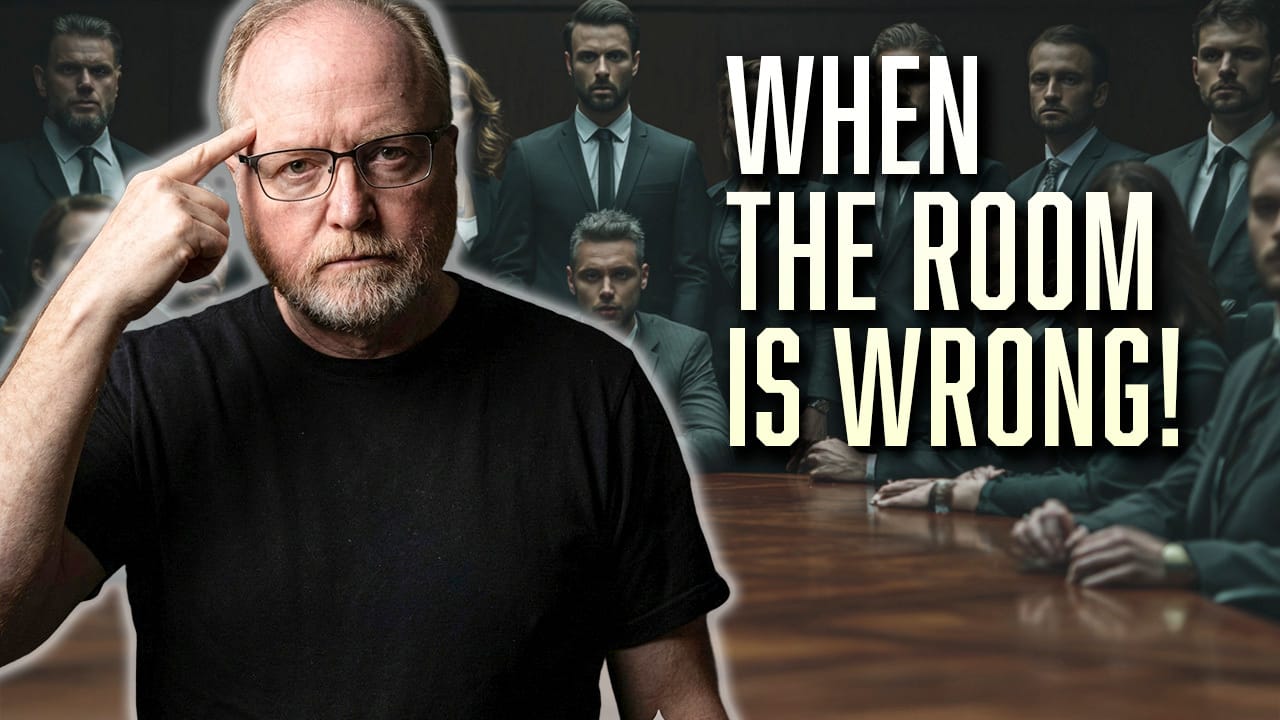
We'll get to that study in a minute. But first, I want you to remember the last time you were in a meeting, and you knew something was wrong. The numbers didn't add up. The risk was being underestimated. And someone needed to say it.
Then the most senior person in the room spoke first: "I think this is exactly what we need."
Heads nodded. Finance agreed. Marketing agreed. The consultant agreed. And by the time it was your turn, you heard yourself saying, "I have some minor concerns, but overall I think it's solid."
You're not alone. Research shows that roughly half of employees stay silent at work rather than voice a concern. And among those who stayed quiet, 40% estimated they wasted 2 weeks or more replaying what they didn't say. Two weeks. Mentally rehearsing the point they should have made in a meeting that's already over.
That silence isn't a character flaw. It's your neurology working against you. And today I'm going to show you exactly why it happens and how to stop it.
It starts with what was happening inside your head during that meeting you just remembered.
.. or the podcast
Why Your Brain Surrenders to the Group
Most people know about the Asch conformity experiments from the 1950s. People were asked to match line lengths, and seventy-five percent went along with answers that were obviously wrong. That result gets cited everywhere. But the more important study came fifty years later, and it revealed something the Asch experiment never could.
In 2005, neuroscientist Gregory Berns at Emory University put people inside an MRI machine and ran a similar conformity task, this time with three-dimensional shape rotation. Like Asch, he planted actors who gave wrong answers. But unlike Asch, he could watch what was happening inside people's brains while the conformity was occurring.
Berns expected the MRI to show activity in the prefrontal cortex, the brain's decision-making center, when people went along with wrong answers. That would mean they were knowingly lying to fit in. Just a social calculation.
That's not what the scans showed.
People who conformed showed no increased activity in decision-making regions. Instead, the activity showed up in the parts of the brain that handle visual and spatial perception, the occipital and parietal areas. The group wasn't changing people's answers. It was changing what they actually saw. Their brains were rewriting their experience to match the room.
And the people who resisted the group? Their scans told a different story. Heightened activity in the amygdala, the brain's threat detection center. The same circuitry that fires when you encounter physical danger lit up when someone disagreed with the group. Berns put it plainly. The fear of social isolation activates the same neural machinery as the fear of genuine threats to survival.
When you caved in that meeting, your neurology wasn't malfunctioning. It was doing exactly what it was designed to do. Keep you safe inside the tribe. This is why what I call mindjacking works so well. Algorithms manufacture social proof by showing you what's trending, what your friends liked, and what similar people chose. Your wiring responds the same way it does at the conference table.
You're fighting your own threat-detection system every time you try to hold an independent position within a group. You can't turn off the wiring. But you can learn to catch it in the act. And that starts with one critical distinction.
Enjoying this? Studio Notes delivers innovation decision insights to your inbox.
The First Skill: Separating Updating from Caving
Sometimes the people around you know something you don't. Changing your mind in a group isn't always a surrender. Sometimes it's the smartest move in the room. The real skill is knowing which one just happened.
You can test this in real time. When you feel your position shifting in a group, ask yourself three questions.
First: Did someone introduce information I didn't have before? If the CFO reveals a data point that genuinely changes the calculus, updating your view isn't a weakness. It's intelligence. That's new evidence.
Second: Can I articulate why I changed my mind, in specific terms? If you can say, "I shifted because of the margin data in Q3 that I hadn't seen," that's a real update. If you can only say, "I don't know, everyone seemed to think it was fine," that's capitulation.
Third: Would I have reached this same conclusion alone, with the same information? This is the killer question. If the answer is no, and you only arrived at this position because others were already there, you haven't updated. You've surrendered.
Getting this wrong is costly. And not just the one time. When you capitulate and call it updating, you train yourself to stop trusting your own analysis. Do it enough times, and you won't even bother preparing, because you already know you're going to defer. That's how capable people slowly become passengers in rooms where they should be driving.
Capture those three questions somewhere you'll see them. They're your real-time check on whether you're being open-minded or spineless.
Those questions work when you're already in the meeting and the pressure is live. But what if you could protect your thinking before the pressure even starts?
The Pre-Meeting Lock-In
The most important thing you can do to protect your independent thinking doesn't happen during the meeting. It happens before.
I call it the Pre-Meeting Lock-In, and it takes less than two minutes.
Before any meeting where a decision will be made, write down three things:
- Your position
- Two or three key reasons supporting it
- What would it take to change your mind
Put it on paper. Put it in a note on your phone. Just get it out of your head and into a form you can reference.
Why does this work? Because once the discussion starts, your mind is going to quietly edit your memories of what you believed. You'll start thinking, "Well, I wasn't really sure about that point anyway." Your pre-meeting notes are an anchor against that self-deception. They're a record of what you actually thought before the social pressure arrived.
You want to see what happens when someone has the analysis but doesn't lock it in?
The night before the Challenger launch in January 1986, engineer Roger Boisjoly and his team at Morton Thiokol had the data. They knew the O-ring seals were dangerous in cold weather. They'd written memos. They'd run the numbers. They recommended against launching.
But when NASA pushed back hard on the teleconference, Thiokol management called an off-line caucus and excluded the engineers from the room. When the call resumed, management reversed the recommendation. Boisjoly had the analysis. His managers had heard it. But under pressure from their biggest customer, the conclusion got edited in real time. Boisjoly later described it as an unethical forum driven by what he called "intense customer intimidation." He fought like hell, but the room won.
That's the most extreme version of the problem. Life and death. But the mechanics are the same in every conference room. The analysis exists. The pressure arrives. And without something anchoring you to what you actually concluded, the room rewrites the story.
There's a bonus effect to the Lock-In, too. When you've documented what it would take to change your mind, you've given yourself permission to be genuinely open. You're not being stubborn for the sake of it. You're saying, "Show me evidence that meets this threshold, and I'll update." That's intellectual honesty with a backbone.
But you can know exactly what you think and still fail if you can't get anyone else to hear it.
How to Dissent and Actually Be Heard
Most dissent fails not because it's wrong, but because it's delivered badly.
Blurting out "I think this is a mistake" when the group is already aligned feels like an attack. People get defensive. Your point gets ignored, not because it lacked merit, but because your delivery threatened the group's cohesion. You triggered the same threat response in them that you've been learning to manage in yourself.
Charlan Nemeth, a psychologist at UC Berkeley, has studied dissent for decades. You'd expect her research to show that dissent helps groups when the dissenter is right. When someone spots a flaw that everyone else missed. That makes intuitive sense.
But that's not what she found. Nemeth discovered that when someone voices a genuine minority opinion, the entire group thinks more carefully. They consider more information, examine more alternatives, and reach better conclusions. And the group benefits even when the dissenter turns out to be wrong. Even when you're wrong, the act of dissenting makes the group smarter. Your disagreement forces everyone out of autopilot. Decades of research by Moscovici supports this. Minority voices don't just influence people in the moment. They shift perception afterward, in private, long after the meeting ends.
That's the good news. The catch is in how the dissent happens.
Nemeth tested what happens when dissent is assigned rather than authentic, when someone plays devil's advocate because they were told to. It doesn't produce the same effect. Groups can tell when disagreement is performative. The cognitive benefits only show up when the dissent is authentic. When someone actually believes what they're saying.
That means the goal isn't just to voice disagreement. It's to voice it in a way that people can actually receive. And the hardest version of this isn't when you have a minor concern about an otherwise good plan. It's when the whole direction is wrong, and finding something to praise would be dishonest.
In those moments, the move is to separate the people from the position. "I respect the work that went into this, and I know this isn't what anyone wants to hear, but I think we're solving the wrong problem." You're honoring the effort while challenging the direction. You're not attacking the tribe. You're trying to save it from a bad bet.
When the stakes are lower, and you do see genuine merit, you can lead with that. "The market timing argument is strong, and I want to make sure we've stress-tested one thing before we commit." Same principle. You're working with their wiring instead of against it.
Either way, your dissent has value beyond being right. Remember that. It's worth holding onto when your amygdala is screaming at you to stay quiet.
Everything so far has assumed you're in a room with other people. Your amygdala can't tell the difference between a conference table and a phone screen.
The Rooms You Can't See
You're not just in meetings. You're in invisible rooms all day long. And most of the time, you don't even know you've walked into one.
Every time you scroll past a post with ten thousand likes and think, "I guess that's the right take." Every time you read three articles with the same conclusion and stop questioning it. Every time an algorithm shows you what similar people chose, and you choose it too. Those are rooms full of nodding heads. And your amygdala responds to them the same way it responds to the conference table.
Think about the last time you researched a major purchase. You probably started with some idea of what you wanted. Then you read reviews. Then you checked what was trending. Then you asked friends. By the time you decided, how much of that decision was yours? How much of it was the room?
Or think about how you form opinions on topics you haven't studied deeply. You read a few articles. They mostly agree. You adopt the consensus. That feels like research. But Berns' scans tell us what's actually happening. Your brain isn't independently weighing the evidence. It's detecting a consensus and rewriting your perception to match. The same process that happens at the conference table is happening every time you open your phone.
Mindjacking doesn't need to override your thinking. It just needs to make sure you never finish thinking for yourself before the crowd's answer arrives. And once it arrives, your neurology does the rest. The group doesn't just influence your answer; it shapes it. It rewrites your perception.
The Lock-In works for these invisible rooms, too. Before you research a major purchase, write down what you actually want and what you're willing to pay. Before you dive into reviews and opinions, commit your criteria to paper. Before you ask friends what they think about a decision you've already analyzed, record your conclusion. Give yourself the same protection from algorithmic conformity that you'd want before walking into a boardroom.
The skill isn't being contrarian. It's being first. First, to your own conclusion, before the room, any room, gets a vote.
This is your challenge for the week. Think of one meeting you have coming up where a decision will be made. Before you walk in, open your notes app and type three lines. Line one: what you think. Line two: why. Line three: what would change your mind. That's it. Then sit in that meeting and watch what happens to your thinking when the room pushes back. I think you'll surprise yourself.
What if the person you can't resist isn't your boss, your colleagues, or the algorithm? What if it's you? What happens when the decision you need to make threatens something deeper, when being wrong would mean something unbearable about who you are? That's where we're headed next.
Never miss a post from Studio Notes
Get innovation decision insights delivered to your inbox. Free or paid — your choice.
Endnotes/References
- "roughly half of employees stay silent at work rather than voice a concern" / "forty percent estimated they wasted two weeks or more": VitalSmarts, Costly Conversations: Why The Way Employees Communicate Will Make or Break Your Bottom Line (Provo, UT: VitalSmarts, December 2016). In a study of 1,025 employees, 70 percent reported instances where they or others failed to speak up effectively when a peer did not pull their weight. Half wasted seven days or more avoiding crucial conversations. Forty percent estimated they wasted two weeks or more ruminating about the problem. A 2021 follow-up study by Crucial Learning (formerly VitalSmarts) of 1,100 people found the rumination figure had risen to 43 percent. The script's "roughly half" is drawn from the VitalSmarts finding that the majority of the workforce reported conversation failures, with half losing seven or more days to avoidance behaviors. Primary source: https://www.vitalsmarts.com/press/2016/12/costly-conversations-why-the-way-employees-communicate-will-make-or-break-your-bottom-line/. Follow-up study: https://cruciallearning.com/press/costly-conversations-how-lack-of-communication-is-costing-organizations-thousands-in-revenue/
- "the Asch conformity experiments from the 1950s": Solomon E. Asch, "Effects of Group Pressure upon the Modification and Distortion of Judgments," in Groups, Leadership and Men, ed. Harold Guetzkow (Pittsburgh: Carnegie Press, 1951), 177–190. The expanded report was published as Solomon E. Asch, "Studies of Independence and Conformity: I. A Minority of One Against a Unanimous Majority," Psychological Monographs: General and Applied 70, no. 9 (1956): 1–70. Asch conducted the line-judgment experiments at Swarthmore College. Participants judged which of three comparison lines matched a standard line, with confederates unanimously giving incorrect answers on critical trials. Across conditions, approximately 75 percent of participants conformed at least once, and the mean conformity rate was approximately one-third of critical trials. Group sizes varied across experiments, typically with 6–8 confederates and one real participant. https://psycnet.apa.org/record/1952-00803-001
- "neuroscientist Gregory Berns at Emory University put people inside an MRI machine": Gregory S. Berns, Jonathan Chappelow, Caroline F. Zink, Giuseppe Pagnoni, Megan E. Martin-Skurski, and Jim Richards, "Neurobiological Correlates of Social Conformity and Independence During Mental Rotation," Biological Psychiatry 58, no. 3 (August 1, 2005): 245–253. doi:10.1016/j.biopsych.2005.04.012. The study used functional magnetic resonance imaging with a mental rotation task. Participants (n=32, ages 19–41) judged whether three-dimensional shapes were rotated versions of each other while four confederates provided answers. Conformity was associated with functional changes in the occipital-parietal network (visual and spatial perception regions), not the prefrontal cortex. Independence was associated with heightened activity in the right amygdala and right caudate nucleus, regions linked to emotional salience and threat detection. https://pubmed.ncbi.nlm.nih.gov/15978553/
- "The group wasn't changing people's answers. It was changing what they actually saw": Berns et al., "Neurobiological Correlates of Social Conformity," 245–253. The researchers isolated the specifically social element of conformity by comparing brain activation when wrong answers came from a group of people versus when they came from computers. Conformity to group-sourced wrong answers produced greater activation bilaterally in visual cortex and right intraparietal sulcus, overlapping the baseline mental rotation network. Berns interpreted this as evidence that social conformity operates at a perceptual level rather than merely at a decision-making level. Full text PDF: https://pdodds.w3.uvm.edu/files/papers/others/2005/berns2005.pdf
- "Heightened activity in the amygdala": Berns et al., "Neurobiological Correlates of Social Conformity," 245–253. Participants who gave independent (correct) answers when the group was wrong showed significantly increased activation in the right amygdala and right caudate nucleus. The amygdala is associated with processing emotionally salient stimuli and threats. Berns described these findings as "consistent with the assumptions of social norm theory about the behavioral saliency of standing alone." The script's characterization that "the fear of social isolation activates the same neural machinery as the fear of genuine threats to survival" is an accessible paraphrase of this finding, consistent with the broader social pain literature (e.g., Eisenberger, Lieberman, & Williams, 2003), though Berns' paper does not use that exact language. https://pubmed.ncbi.nlm.nih.gov/15978553/
- "engineer Roger Boisjoly and his team at Morton Thiokol had the data": Roger M. Boisjoly, "Ethical Decisions — Morton Thiokol and the Space Shuttle Challenger Disaster" (paper presented at the American Society of Mechanical Engineers Annual Meeting, December 13–18, 1987). First presented as a talk at MIT in January 1987. Boisjoly, a specialist in O-ring seals and rocket joints at Morton Thiokol, documented how engineers recommended against the January 28, 1986 launch based on concerns about O-ring performance in cold temperatures. During the pre-launch teleconference, Thiokol management called an off-line caucus, excluded the engineers, and reversed the no-launch recommendation under pressure from NASA. Boisjoly described the forum as constituting "the unethical decision-making forum" driven by customer pressure. He was awarded the Prize for Scientific Freedom and Responsibility by the American Association for the Advancement of Science. The Online Ethics Center at the National Academy of Engineering hosts Boisjoly's full account: https://onlineethics.org/cases/ethical-decisions-morton-thiokol-and-space-shuttle-challenger-disaster-introduction. See also Russell P. Boisjoly, Ellen Foster Curtis, and Eugene Mellican, "Roger Boisjoly and the Challenger Disaster: The Ethical Dimensions," Journal of Business Ethics 8, no. 4 (April 1989): 217–230. doi:10.1007/BF00383335. https://link.springer.com/article/10.1007/BF00383335
- "Nemeth discovered that when someone voices a genuine minority opinion, the entire group thinks more carefully": Charlan J. Nemeth, In Defense of Troublemakers: The Power of Dissent in Life and Business (New York: Basic Books, 2018). Nemeth's research program at UC Berkeley, spanning four decades, demonstrated that exposure to minority dissent stimulates divergent thinking, broader information search, consideration of more alternatives, and higher-quality group decisions. The finding that dissent improves group performance even when the dissenter turns out to be wrong is documented across multiple studies. See also Charlan J. Nemeth, "Minority Influence Theory," IRLE Working Paper No. 218-10 (Berkeley: Institute for Research on Labor and Employment, May 2010). https://escholarship.org/uc/item/1pz676t7
- "Decades of research by Moscovici": Serge Moscovici, Elisabeth Lage, and Martine Naffrechoux, "Influence of a Consistent Minority on the Responses of a Majority in a Color Perception Task," Sociometry 32, no. 4 (December 1969): 365–380. In the original experiment, participants viewed blue slides while two confederates consistently called them green. The consistent minority condition produced a shift in approximately 8 percent of majority judgments toward the minority position, and roughly one-third of participants conformed at least once. In the inconsistent minority condition, the effect was negligible (approximately 1.25 percent). The script's claim that "minority voices don't just influence people in the moment — they shift perception afterward, in private" draws on Moscovici's subsequent conversion theory and research on the delayed and private effects of minority influence, including afterimage studies showing genuine perceptual shifts. https://www.jstor.org/stable/2786541
- "Nemeth tested what happens when dissent is assigned rather than authentic": Charlan J. Nemeth, Joanie B. Connell, John D. Rogers, and Keith S. Brown, "Improving Decision Making by Means of Dissent," Journal of Applied Social Psychology 31, no. 1 (2001): 48–58. doi:10.1111/j.1559-1816.2001.tb02481.x. Groups deliberated a personal injury case under three conditions: authentic dissent (a genuine minority viewpoint), assigned devil's advocate (a member told to argue the opposing side), and no dissent. Authentic dissent was superior in stimulating consideration of opposing positions, original thought, and direct attitude change. The devil's advocate condition did not produce the same cognitive benefits, suggesting that groups detect and discount performative disagreement. https://onlinelibrary.wiley.com/doi/abs/10.1111/j.1559-1816.2001.tb02481.x. See also Charlan Nemeth, Keith Brown, and John Rogers, "Devil's Advocate versus Authentic Dissent: Stimulating Quantity and Quality," European Journal of Social Psychology 31, no. 6 (2001): 707–720. doi:10.1002/ejsp.58.