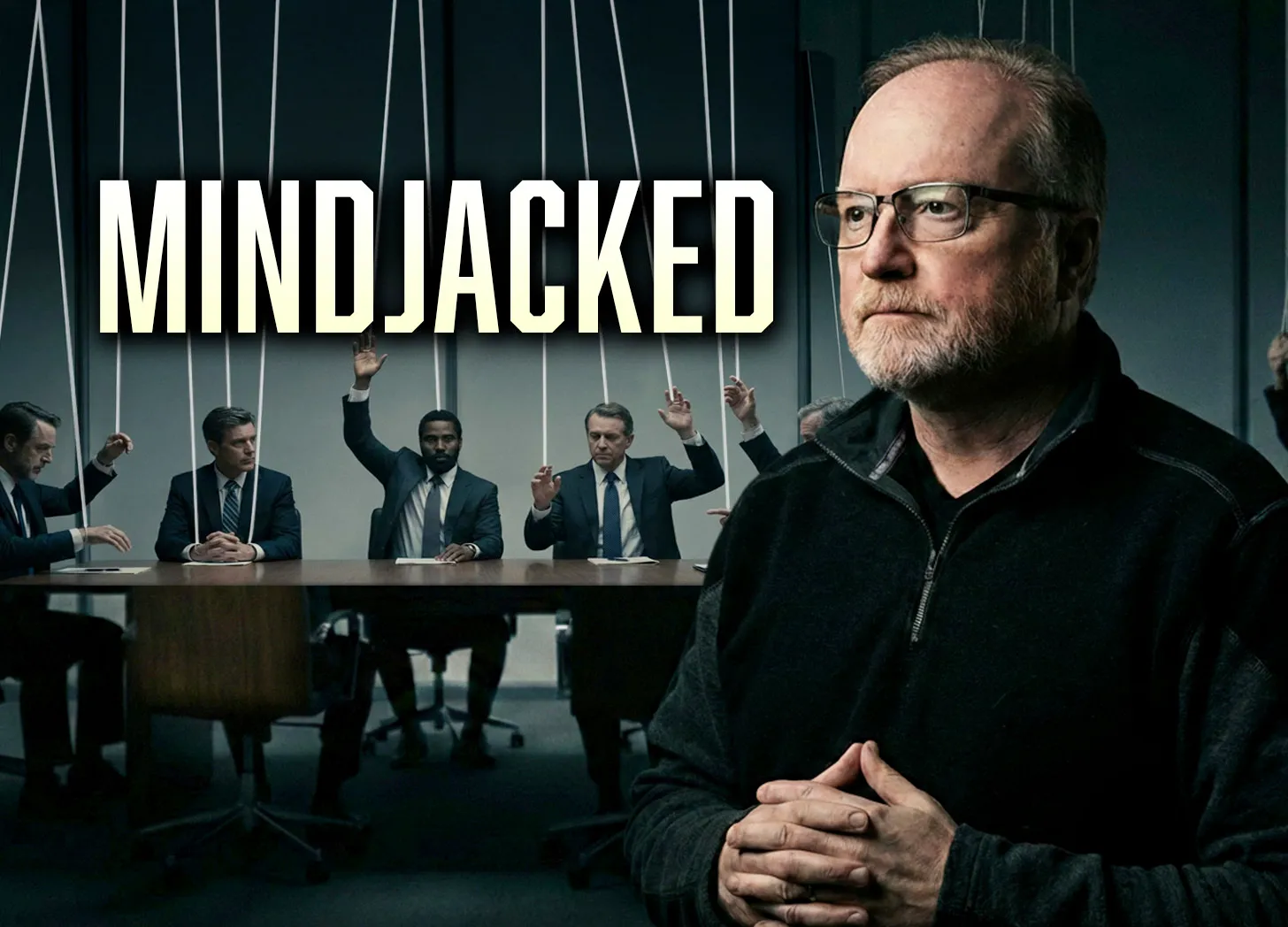
Mindjacking: When Your Opinions Aren't Yours
Every day you make decisions you think are yours. Most aren't. The algorithm decided, the expert weighed in, the crowd chose. You just clicked agree.


You've built a toolkit over the last several episodes. Logical reasoning. Causal thinking. Mental models. Serious intellectual firepower.
Now the uncomfortable question: When's the last time you actually used it to make a decision?
Not a decision you think you made. One where you evaluated the options yourself. Weighed the evidence. Formed your own conclusion.
Here's what most of us do instead: we Google it, ask ChatGPT, go with whatever has the most stars. We feel like we're deciding, but we're not. We're just choosing which borrowed answer to accept.
That gap between thinking you're deciding and actually deciding is where everything falls apart. And there's a name for it.
.. or listen to the podcast:
What Mindjacking Actually Is
Not the sci-fi version where hackers seize your brain through neural implants. The real version. Where you voluntarily hand over your thinking because someone else already did the work.
It's not dramatic. It's convenient. The algorithm ranked the results. The expert weighed in. The crowd already decided. Why duplicate the effort?
Mindjacking is different from ordinary influence. You choose it. Every single time. Nobody forces you to stop evaluating. You volunteer, because forming your own conclusion is harder than borrowing someone else's.
What exactly are you losing when this happens?
The Two Skills Under Attack
Mindjacking destroys two distinct capabilities. They're different, and you need both.
Evaluation independence is the ability to assess whether a claim is valid. Not whether the source has credentials. Not whether experts agree. Whether the evidence actually supports the conclusion.
Decision independence is the ability to commit to a path based on your own judgment, without needing someone else to validate it first.
Both skills need each other. Watch what happens when one erodes faster than the other.
A woman researches her medical condition for hours. Journal articles. Treatment comparisons. She understands her options better than most medical students would. She walks into the doctor's office, lays out her analysis. It's thorough. Sophisticated, even.
The doctor reviews it and says, "This is impressive. You've really done your homework."
She nods. Then looks up and asks: "So what should I do?"
She can evaluate. She can't decide.
Now flip it. Think about someone who decides fast. Trusts their gut. Never waits for permission. How often does that person get burned by bad information they never verified?
They can decide. They can't evaluate.
Lose either ability and you're trapped. Lose both and you're not thinking at all.
The Four Surrender Signals
How do you know when mindjacking is happening? It has a signature. Four internal signals that reveal the handoff in progress, if you know how to read them.
Signal one: Relief. The moment you find "the answer," you notice a weight lifting. Pay attention to that. Relief isn't insight. It's the burden of thinking being removed. When you actually work through a problem yourself, the result isn't relief. It's clarity. And clarity usually comes with new questions, not a sense of "done."
Signal two: Speed. Uncertainty to certainty in seconds? That's not evaluation. You found someone else's answer and adopted it. There's a difference between "I figured it out" and "I found someone who figured it out." One took effort. The other took a search bar.
Signal three: Echo. Listen to your own conclusions. Do they sound like something you read, heard, or scrolled past recently? If your "own opinion" matches a headline almost word-for-word, it probably isn't yours. You're not thinking. You're repeating.
Signal four: Unearned confidence. You're certain about a conclusion, but ask yourself: could you explain the reasoning behind it? Not where you heard it. The actual reasoning. If you can't, that confidence isn't yours. It came attached to someone else's answer, and you absorbed both their conclusion and their certainty without doing any analysis yourself.
Once you notice these signals firing, you need a way to stop the pattern before it completes.
The Interrupt
The interrupt is a single question:
"Did I reach this conclusion, or just find it?"
Six words. That's the whole thing.
It works because it forces a distinction your brain normally blurs. "I decided" and "I adopted someone's decision" are identical from the inside, until you ask the question.
Test it now. Think about the last opinion you formed. The last purchase you made. The last recommendation you accepted.
Did you reach that conclusion, or just find it?
The interrupt doesn't tell you what to think. It tells you whether you're thinking at all.
Finding an answer isn't the same as reaching one.
This matters more than you might realize, because the pattern is bigger than any single decision you make.
The Aha Moment: The Illusion of Expertise
Researchers at Penn State looked at 35 million Facebook posts and found something remarkable: seventy-five percent of shared links were never clicked. Three out of four times, people passed along articles they hadn't read.
But that's not the strange part.
A separate study from the University of Texas discovered that the act of sharing content, even content you haven't read, makes you think you understand it. Sharing tricks you into believing you know. You didn't read the article about investing, but you shared it, so now you believe you understand investing.
Worse: people act on that false knowledge. In the study, people who shared an investing article took significantly more financial risk afterward, even though they never read what they shared.
They weren't pretending to know. They genuinely believed they knew, because sharing had become a substitute for learning.
That's mindjacking at scale. Millions of people believing they're informed, acting confident, having never actually thought about any of it.
The Feed Challenge
I want you to try something as soon as this video ends.
Open your social media feed. Find a post where someone you know has liked or shared an article, an opinion, a hot take.
Now ask: Did they actually think about this? Or did they just pass it along?
Look for the signals. Is their comment just echoing the headline? Are they expressing certainty about something they probably spent ten seconds on? Did they add anything that suggests they read past the first paragraph? Or did they just click "like" and move on? Remember: seventy-five percent of shared links are never clicked. That like or share you're looking at? They probably never read what they're endorsing.
You'll be shocked how easy this becomes once you start looking. It's everywhere. People confidently endorsing opinions they never examined. Certainty without evaluation. Expertise without effort.
Why start with what others are putting in your feed? Because it's much easier to spot mindjacking in others than in yourself. Your ego doesn't interfere. Train your eye on what's coming at you first. Then turn it inward.
Awareness precedes choice. You can't reclaim what you can't see.
What's Next
Now you can see the handoff happening. That's the foundation. But seeing it isn't enough.
Knowing the signals won't help you when you're exhausted and the algorithm is offering relief. Understanding the trap won't save you when everyone in the room disagrees and consensus feels like safety. Awareness alone won't protect you when the deadline is tomorrow and you don't have time to think.
Those are the moments where mindjacking wins. Not because you lack the ability to think, but because thinking starts to look like a luxury you can't afford.
That's the real battle. And that's what comes next.
Next, we tackle the hardest version of this problem: acting before you're ready. What happens when you have to decide, the information isn't complete, and it never will be? Waiting for certainty feels responsible. But sometimes, waiting is the trap.
If you're new here, check out the earlier episodes where we built the evaluation toolkit this series is built on. Watch the series on YouTube.
Don’t Click Yet
Here's a thought: most people will finish this video and scroll to the next one. The algorithm already has a recommendation queued up. Relief is one click away.
But you could do something different. You could stick with the discomfort for a minute. Actually, try the feed challenge before moving on.
If you want to go deeper on mindjacking, the full breakdown lives at philmckinney.com/mindjacking. And if you want to support the team that helps me to produce this content, consider becoming a paid subscriber on Substack.
Now, drop a comment below: What's one opinion you realized might not actually be yours? And share this with someone who needs to hear it.
References
- Penn State University (2024). "Social media users probably won't read beyond this headline, researchers say." Analysis of 35 million Facebook posts published in Nature Human Behaviour.
- Ward, A., Zheng, J.F., & Broniarczyk, S.M. (2022). "I share, therefore I know? Sharing online content – even without reading it – inflates subjective knowledge." Journal of Consumer Psychology, University of Texas at Austin McCombs School of Business.