PayPal Spends $3 Billion on R&D. Almost None of It Is Research.
Enrique Lores just inherited a research gap a decade in the making. Here's what it will take to fix it.

On February 3rd, PayPal's board fired its CEO, Alex Chriss, and named its own chairman, Enrique Lores, as his replacement.
The official diagnosis: execution failure.
If that name sounds familiar, it should. Lores spent six years as CEO of HP Inc. before joining PayPal's board in 2021 and becoming its chair in July 2024. Understanding what he's actually walking into, not just the execution gap but the deeper structural one, matters more than the board narrative suggests.
The Situation Lores Is Actually Inheriting
This isn't the first time a technology company's board has moved its own chairman into the CEO role to stabilize a company in transition. The template is familiar, and the instinct behind it is often sound. Internal promotions reduce transition risk. A chairman who has watched the strategy up close can move faster than an outside hire who needs six months of orientation.
But the move carries a structural blind spot worth naming. When the chair becomes the CEO, the accountability narrative naturally concentrates on the departing executive. What the institution built over years, the spending patterns, the strategic priorities, the questions that were and weren't being asked, tends to get folded into the "execution failure" frame rather than examined on its own terms.
The HP parallel is instructive here, not as a critique but as a map. In 2011, HP's board promoted its own chair, Meg Whitman, after firing Léo Apotheker. Whitman successfully stabilized operations. The deeper structural questions about HP's research investment and long-term innovation capacity took longer to surface, and they surfaced at a cost.
Lores sat in the chair's seat for the eighteen months preceding his appointment. He watched the R&D ratio the board had overseen for years, through the 2023 and 2024 restructurings, through declining patent output, through every quarter of flat research investment, while $6 billion per year went back to shareholders in buybacks. He arrives with full situational awareness. That is an asset. The question is whether the diagnosis he brings with him matches the full scope of what he's looking at.
Enjoying this? Studio Note delivers innovation decision insights to your inbox.
Where the $3 Billion Actually Goes
The conditions he's inherited show up most clearly in one number.
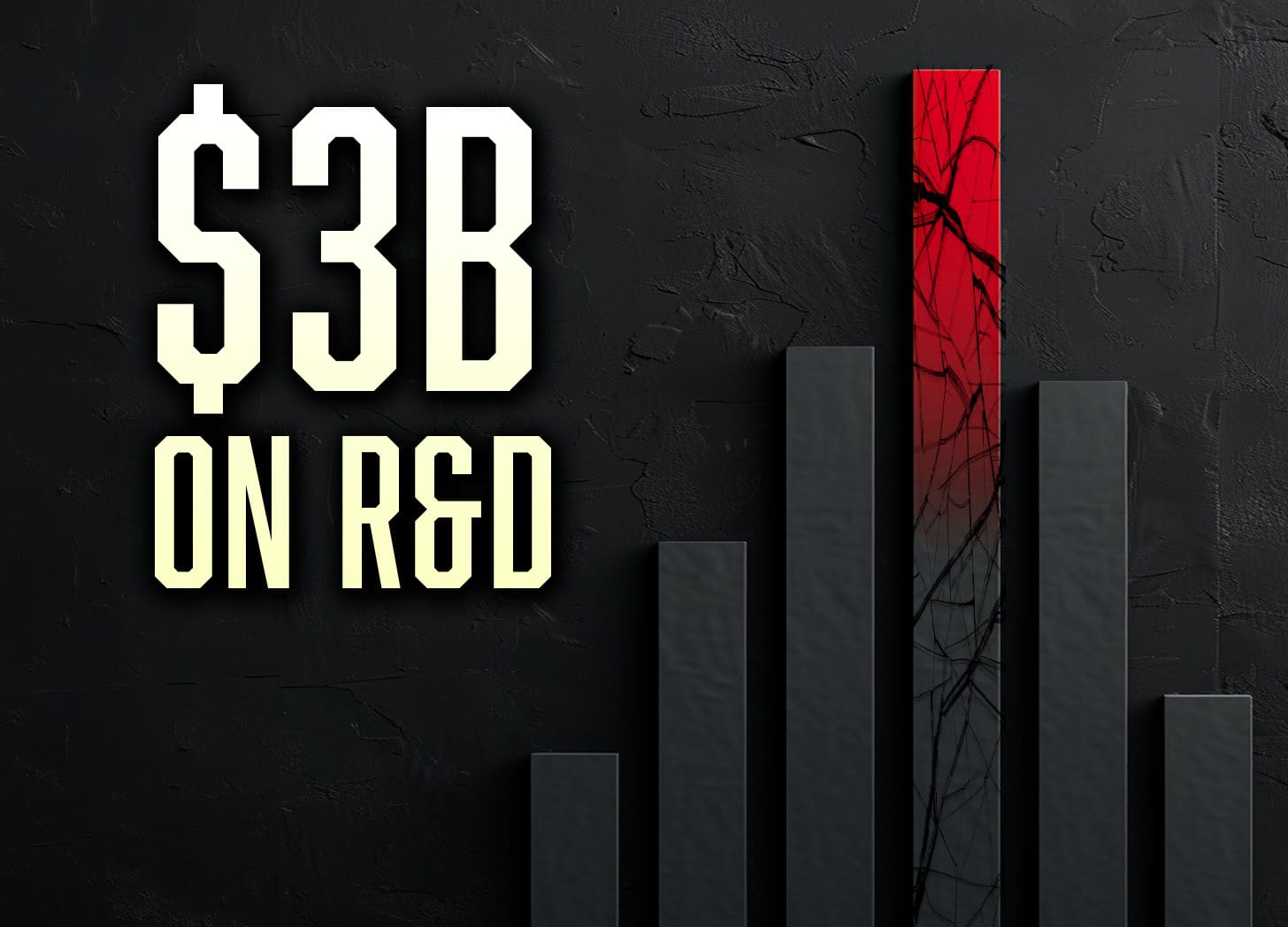
PayPal spent $3.1 billion on what it calls "Technology and Development" in FY2025. The company defines that line in its 10-K this way:
"The development of new and enhanced products and services, maintenance of existing products and services, and costs of our technology infrastructure."
Product development, sustaining engineering, and infrastructure maintenance, all collapsed into one number. That's the figure in the headlines. It's also the number that hides what's actually happening.
The FY2025 10-K contains a disclosure that changes the read entirely: "research and development expense was $1.5 billion in both 2025 and 2024." That $1.5 billion is the portion PayPal's own accountants formally classify as R&D. The remaining $1.6 billion is operations and infrastructure, the engineering that keeps the existing platform running.
Think of it as three buckets.
Operational Spend: The first $1.6 billion keeps the lights on: operations, infrastructure, the engineering that makes sure 25 billion transactions don't fail each year.
Product Development: The second $1.3 billion builds improvements to products that already exist: better checkout, new Venmo features, platform expansion.
Research: The third bucket is the work that explores what doesn't exist yet. Our best estimate from public disclosures, since PayPal doesn't break this out and any such estimate requires assumptions, is $120 to $180 million.
That's roughly 5 cents of genuine research for every dollar PayPal reports as Technology and Development.
We score that using the Innovation Signal Index, an analytical framework that looks past reported R&D spending to estimate innovation health PayPal's ISI grade: D-. A decade in the making.
How the Number Got This Way
The story runs through 2021, when PayPal's Technology and Development line jumped from $1.4 billion to $3.0 billion in a single year. That doubling gets cited as evidence of serious research investment. It was accounting, not research.
PayPal acquired Honey Science Corporation in 2020 and Paidy in 2021, bringing in large development engineering teams whose compensation costs flowed directly into the Technology and Development line. The headcount jumped from roughly 26,500 to nearly 31,000. The Technology and Development line doubled. The research output didn't. Patent grants ticked up modestly. The research-to-development ratio got worse.
This is the structural reality Lores is stepping into: a $3.1 billion line that generates roughly $150 million in genuine research, with the gap having widened steadily across years of board-level budget decisions. Chriss didn't build this condition. He ran on the foundation that was already laid when he arrived in 2023.
That distinction matters because the fix for an execution problem and the fix for a research-investment problem are fundamentally different. Execution fixes are faster. Research investment fixes are slower and require protecting budget lines that don't show returns for three to five years. Knowing which problem you have determines whether you can solve it.
What the Patent Trail Confirms
Research produces knowledge. Knowledge produces patents. The output trend tells a clear story.
In 2017 and 2018, before the acquisition surge, PayPal generated roughly 340 patent grants per year with approximately 18,000 employees. About 19 patents per 1,000 employees.
By 2025, headcount had grown to approximately 24,400 and annual patent grants had fallen to an estimated 190. About 8 per 1,000 employees.
Knowledge output per employee fell by more than half over seven years, while the Technology and Development budget more than doubled. More money, more people, less discovery.
The peer contrast is structural rather than numerical. Visa runs a named research organization, Visa Research, that produces publishable academic work. Mastercard has its Foundry, a dedicated unit where teams design, test, and launch new payment technologies. PayPal has no equivalent. No named lab. No published research agenda. No organizational home for discovery.
On raw patent counts per employee, these companies are in a similar range today. The difference is that Visa and Mastercard have built institutional infrastructure for research to compound over time. PayPal has not. That gap doesn't show up in a single year's patent count. It shows up a decade later, when the knowledge reserve runs thin, right around the window Lores is now operating in.
The Question the Numbers Are Asking
The patent data tells you what happened. The harder question is what to do about it.
Boards are very good at the development question. Is the product getting better? Is conversion improving? Is Venmo monetizing? Is the platform scaling? These are legitimate questions and they don't disappear. Execution on them is a real job.
The innovation question sits alongside it, and it doesn't get asked as often: Are we building the foundation that makes the products of 2030 possible? Do we have a research organization discovering things nobody else knows yet? Are we producing the IP that will define the next competitive cycle, or are we maintaining the assets we built in the last one?
PayPal's competitive position today, its 439 million active accounts, its two-sided network, its checkout presence, reflects investments made primarily between 2000 and 2015. The current Technology and Development program is sustaining those assets. It is not yet building new ones at the rate the next competitive cycle will require.
Stripe is investing in the knowledge base for what payments becomes in 2035. Adyen is doing it. Mastercard and Visa are doing it. The window to close that gap while the balance sheet is strong is now. Waiting until the competitive pressure is visible means waiting until the lead time for research to compound has already been spent.
This is the strategic choice in front of Lores, and it's a harder one than "execute better." Execution optimizes the present. Research builds the future. The D- grade reflects a decade of development-first prioritization. Reversing it requires a deliberate decision to protect research budget against the quarterly pressure that always argues for more near-term spend.
What the First Moves Could Signal
Lores's public statement on appointment was precise:
"We will further strengthen the culture of innovation necessary to deliver long-term transformation and balance this with near-term delivery, executing with greater speed and precision."
There is genuine room in that statement for the innovation question. "Long-term transformation" and "culture of innovation" are the opening. What fills them in over the next two to three quarters will tell the real story.
The markers worth watching aren't in earnings calls. They're in organizational moves:
Does PayPal announce a named research organization with a protected budget and a leader whose job depends on its output? Does the board add a director with a research and development background to complement the operational bench it already has? Does the IP strategy shift from sustaining-mode filing toward foundational categories, fraud intelligence, real-time settlement infrastructure, identity and trust, AI capabilities that don't yet exist in payments?
These are the signals that distinguish a research-investment reversal from a faster version of the existing strategy.
At HP Inc., Lores ran a disciplined operational model focused on product evolution, cost efficiency, and margin expansion, and he ran it well. The question PayPal presents is whether he applies that same model here, or whether he sees this moment as an opportunity to build something HP Inc. never had the structural mandate to build. A $33 billion revenue company processing $1.79 trillion annually has the resources to do both: execute well in the near term and make the research investment that compounds over the next decade. That combination is what a D- grade creates the opportunity for. The execution piece is already in his wheelhouse. The research piece is the new call.
What Good Would Look Like
The resources exist. That's what makes the choice so clear.
A genuine research organization at PayPal would have a name and a protected budget, $400 to $500 million annually, with a leader whose job depends on its output. It would have a published research agenda covering payment fraud intelligence, real-time settlement infrastructure, identity and trust, and AI capabilities that don't exist yet, not AI applied to improve the existing checkout flow. It would produce 400-plus patent grants per year with a meaningful share in foundational categories.
None of that exists today. Building it is a three-to-five-year decision, not a quarter-to-quarter one. Which means the time to make it is before the competitive pressure makes it obvious, not after.
The execution question and the innovation question aren't in conflict. The companies that get this right run both tracks simultaneously. They deliver the quarter and protect the research line. They show up in earnings calls with improving margins and in patent databases with compounding output.
PayPal has the scale to do this. It has the balance sheet. What it needs is a board and a CEO willing to add the innovation question to the conversation — not someday, but now, before the knowledge reserve that built this company runs fully thin.
That's the call in front of Enrique Lores. The execution piece is already known. The research investment decision is the one that defines the next decade.
The idea was never the hard part. It never is. Making the call is.
Phil McKinney is the former CTO of Hewlett-Packard and CEO of CableLabs. He writes about innovation and decision-making at philmckinney.com and on Substack.
Disclosure: This article is offered solely in the context of innovation investment health and competitive positioning. Phil McKinney is not a registered investment adviser. The Innovation Signal Index™ (ISI) and any assessments derived from it are analytical tools for evaluating research and development practices, not instruments for evaluating securities. Nothing herein should be construed as investment advice, a recommendation to buy or sell any security, or a solicitation of any investment decision. At the time of publication, the author may hold a position in securities of companies mentioned in this article and may buy or sell such securities at any time without further notice. No compensation was received from any company discussed herein. Readers making investment decisions should consult a qualified financial professional.
Innovation insights from Phil McKinney
Four decades of decisions. Delivered to your inbox.
Free or paid — your choice.
Endnotes/Sources
1. "February 3, 2026: PayPal's board fired CEO Alex Chriss and named Enrique Lores as his replacement."
PayPal Holdings, Inc., Form 8-K, filed February 3, 2026. United States Securities and Exchange Commission. The filing discloses the Board's appointment of Enrique Lores as President and Chief Executive Officer, effective March 1, 2026, and Alex Chriss's simultaneous resignation as President, CEO, and director. https://www.sec.gov/Archives/edgar/data/1633917/000119312526035860/d68718d8k.htm
For the accompanying press release text, including Lores's statement about "greater speed and precision": PayPal Holdings, Inc., Exhibit 99.1 to Form 8-K, February 3, 2026. https://www.sec.gov/Archives/edgar/data/0001633917/000119312526035860/d68718dex991.htm
For news coverage of the appointment: Lynne Marek, "PayPal appoints new CEO," Payments Dive, February 3, 2026. https://www.paymentsdive.com/news/paypal-appoints-new-ceo/811189/
2. "Lores served as PayPal's board chairman for the eighteen months before his appointment as CEO"
Per the SEC 8-K (note 1 above): "Immediately prior to his appointment as President and Chief Executive Officer, Mr. Lores served as Chair of the Board." The PayPal press release (Exhibit 99.1, note 1 above) specifies he "served on the PayPal Board for nearly five years and as Board Chair since July 2024." The Payments Dive article (note 1 above) confirms "Lores's service on PayPal's board, including the past 18 months as chairman."
3. "The HP/Apotheker/Whitman parallel: HP fired its CEO in September 2011 and replaced him with a board member, after the board had approved the Autonomy acquisition"
For the Apotheker firing and Whitman appointment: "Léo Apotheker," Wikipedia. Confirms Apotheker was dismissed on September 22, 2011, replaced by fellow board member Meg Whitman, and that the $10+ billion Autonomy acquisition had closed in October 2011 under board approval. https://en.wikipedia.org/wiki/L%C3%A9o_Apotheker
For the full HP-Autonomy timeline including the board's role and subsequent write-down: Peter Sayer, "The HP-Autonomy lawsuit: Timeline of an M&A disaster," CIO, July 22, 2025. https://www.cio.com/article/304397/the-hp-autonomy-lawsuit-timeline-of-an-ma-disaster.html
4. "PayPal's FY2025 Technology and Development spend was $3.1 billion. The company processed $1.79 trillion in total payment volume, completed 25.4 billion transactions, and ended the year with 439 million active accounts and $33.6 billion in net revenue."
PayPal Holdings, Inc., Annual Report on Form 10-K for the fiscal year ended December 31, 2025, filed February 3, 2026. United States Securities and Exchange Commission. Technology and Development expense, TPV, transaction count, active account count, and net revenue figures all sourced from this filing. https://www.sec.gov/Archives/edgar/data/0001633917/000163391726000024/pypl-20251231.htm
5. "PayPal eliminated approximately 2,500 positions in early 2024"
Lynne Marek, "PayPal appoints new CEO," Payments Dive, February 3, 2026. The article contextualizes the CEO change within the company's recent restructuring history, including the 2024 headcount reductions. The 2,500-position figure is consistent with PayPal's publicly disclosed 2024 restructuring plans, reflected in the FY2025 10-K headcount data (note 4 above), which shows the workforce falling from approximately 29,900 (year-end 2023) to 27,200 (year-end 2024). https://www.paymentsdive.com/news/paypal-appoints-new-ceo/811189/
6. "PayPal's 10-K defines Technology and Development as covering engineering, product development, and what it terms 'research and development' — but does not break out the research component separately"
PayPal Holdings, Inc., Form 10-K for fiscal year ended December 31, 2025 (note 4 above). The T&D line item definition appears in the MD&A section. The 10-K discloses a single blended "Technology and Development" figure and does not separately report a pure research budget. The filing states research and development expense (as a subset of T&D) was approximately $1.5 billion in both FY2025 and FY2024, per the StockTitan AI summary of the filing.
For the StockTitan AI summary of the 10-K, which surfaces the $1.5 billion R&D disclosure: https://www.stocktitan.net/sec-filings/PYPL/10-k-pay-pal-holdings-inc-files-annual-report-0d7a9cc1b582.html
7. "The $1.5 billion R&D disclosure within Technology and Development"
Per the StockTitan summary of the PayPal FY2025 10-K (note 6 above): "The company's research and development expense was $1.5 billion in both 2025 and 2024." This figure represents the subset of T&D that PayPal characterizes as R&D in its financial disclosures, but does not distinguish pure research from product engineering. The primary source is the 10-K itself (note 4 above).
8. "25 billion transactions annually across 439 million active accounts"
PayPal Holdings, Inc., Form 10-K for fiscal year ended December 31, 2025 (note 4 above). Key Performance Metrics section: 25.4 billion payment transactions in FY2025; 439 million active accounts as of December 31, 2025.
9. "PayPal spent approximately $4 billion to acquire Honey in January 2020 and approximately $2.7 billion to acquire Paidy in October 2021"
For Honey: "PayPal Completes Acquisition of Honey," PR Newswire, January 6, 2020. Confirms $4 billion cash consideration. https://www.prnewswire.com/news-releases/paypal-completes-acquisition-of-honey-300981363.html
For Paidy: PayPal Holdings, Inc., Q3 2021 Earnings Release, November 8, 2021, filed with the SEC. Confirms "acquisition of Paidy…for approximately $2.7 billion, principally in cash." https://www.sec.gov/Archives/edgar/data/0001633917/000163391721000167/q3-21paypalearningsrelea.htm
10. "PayPal's headcount grew from approximately 26,500 employees at year-end 2021 to approximately 30,900 at year-end 2022, before declining to 24,400 at year-end 2025"
Bullfincher, "PayPal Holdings Number of Employees 2017–2026." Aggregates PayPal's annual headcount disclosures from SEC filings. Shows 26,500 (2021), 30,900 (2022 peak), 24,400 (2025). https://bullfincher.io/companies/paypal-holdings/number-of-employees
Underlying primary source for all individual year figures is PayPal's annual Form 10-K filings (see note 4 for FY2025).
11. "Headcount reduction from peak of approximately 30,900 to 24,400 — a 21 percent decline from the 2022 peak through year-end 2025"
See note 10 above. Calculation: (30,900 − 24,400) / 30,900 = approximately 21 percent.
12. "PayPal filed approximately 340 patent grants per year in 2017–2018, yielding roughly 19 patents per 1,000 employees"
USPTO patent grant data, directional estimate. PayPal's patent filing activity in 2017–2018 is consistent with published industry analyses of fintech patent output during that period. Headcount denominator: approximately 18,100–18,700 employees (see note 10 above). The per-thousand calculation is illustrative based on directional public data; the specific grant count is an estimate, not an audited figure.
Note: Patent grant totals by assignee are publicly searchable at the USPTO Patent Full-Text Database (https://www.uspto.gov/patents/search ). This figure represents a directional estimate derived from that public data.
13. "By 2025, PayPal's patent output had declined to approximately 190 grants per year, yielding roughly 8 patents per 1,000 employees."
USPTO patent grant data, directional estimate. Headcount denominator: 24,400 employees at year-end 2025 (note 10 above). The per-thousand calculation is illustrative. Same caveats as note 12 apply.
Note: Patent grant totals by assignee are publicly searchable at the USPTO Patent Full-Text Database (https://www.uspto.gov/patents/search ). This figure represents a directional estimate derived from that public data.
14. "Visa maintains Visa Research, a named, institutionalized research organization that publishes academic work"
Visa Research, "About Visa Research." Visa's official research organization page, describing its mission of fundamental and applied research in payments and its published academic output. https://usa.visa.com/about-visa/visa-research.html
Visa Research publications page, confirming peer-reviewed publication activity: https://usa.visa.com/about-visa/visa-research/publications.html
15. "Mastercard operates the Mastercard Foundry, its named innovation and product development hub"
"How Mastercard Technologists Are Shaping Digital Payments," Built In. Describes the Mastercard Foundry as "the company's innovation and product development hub where new payment technologies and digital solutions are designed, tested and launched" and details its R&D team structure. https://builtin.com/articles/how-mastercard-technologists-are-building-future-digital-payments-and-cybersecurity
16. "PayPal's scale: 439 million active accounts, $1.79 trillion in total payment volume, $33.6 billion in net revenue"
PayPal Holdings, Inc., Form 10-K for fiscal year ended December 31, 2025 (note 4 above).
17. "Lores's stated priority: 'executing with greater speed and precision'"
PayPal Holdings, Inc., Exhibit 99.1 to Form 8-K, February 3, 2026. Direct quotation from Lores's statement in the official press release announcing his appointment. https://www.sec.gov/Archives/edgar/data/0001633917/000119312526035860/d68718dex991.htm
Full quote: "We will further strengthen the culture of innovation necessary to deliver long-term transformation and balance this with near-term delivery, executing with greater speed and precision, and holding ourselves accountable for consistent delivery quarter on quarter."
18. "Lores helped architect the HP/HPE separation; HP Labs was significantly reduced in the years surrounding that separation."
For Lores as architect of the HP/HPE separation: PayPal Holdings, Inc., Exhibit 99.1 to Form 8-K, February 3, 2026 (note 17 above). The press release states Lores "was also the lead architect of and built on the HP/HPE separation."
For HP Labs context: The reduction of HP Labs in the years surrounding the 2015 HP/HPE separation is consistent with widely reported coverage of HP's R&D restructuring. This claim rests on the accumulated press record of that period rather than a single citable source and should be treated as directional rather than precisely quantified.