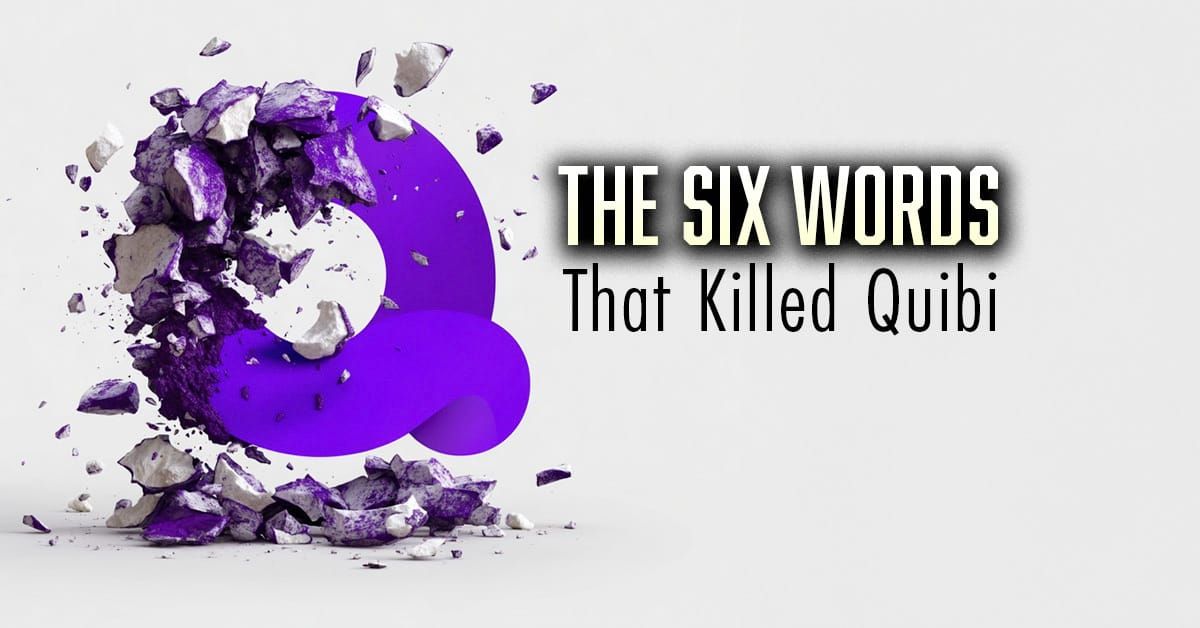
The Six Words That Killed Quibi
Same Skill, Opposite Outcomes: How Jeffrey Katzenberg Built an Empire and Lost a Billion

Your brain doesn’t actually store information as facts—it stores it as patterns and relationships. When you encounter something new, your brain immediately asks: “What is this like?” You can’t turn this off. Every comparison you make is your brain’s way of understanding the world.
This is why analogies are so powerful. And so dangerous.
I worked closely with Jeffrey Katzenberg and Ed Leonard for over seven years. Jeffrey Katzenberg—the man who ran Disney’s animation studios during their renaissance, co-founded DreamWorks, and produced some of the most successful animated films in history—was a master of analogy. Whether pitching a film concept to executives or describing a technical vision to engineers, he used comparison to make the complex immediately understandable. Ed Leonard, as DreamWorks’ CTO, was Jeffrey’s protégé in applying analogies to technology, translating creative vision into technical reality.
During those years, I watched them use analogies to create breakthrough technologies that changed entire industries.
Then, more than a decade later, I watched Jeffrey use an analogy that burned through over a billion dollars in six months.
Same skill. Same instinct. Opposite outcomes.
The skills that built your empire can become the blind spots that destroy it.
This is the real story of what happened—twice. Once when the analogy worked perfectly. Once when it failed spectacularly. And why the difference matters more than any framework can teach you.
Episode 4 dropped last Wednesday: This article reveals what happened when Jeffrey Katzenberg’s analogy failed. Episode 4 shows you the complete framework for using analogies without falling into the same traps—including the five strategies he should have used with Quibi. Subscribe to the series here
When Analogies Work: Building the Room That Shouldn’t Exist
2004. DreamWorks Animation.
Jeffrey Katzenberg sat across from me with a problem: his animation studios were 400 miles apart. PDI in Northern California. Main studio in Burbank.
“I want it to feel like being there,” he said. “In all ways.”
Not “like video conferencing but better.” Not “like a high-quality call.”
Like being there. In all ways.
As CTO at HP, I was part of the deep partnership we had with DreamWorks—a relationship that had started years earlier when we helped them finish the first Shrek film by providing servers to meet impossible deadlines. By 2002, we had a formal strategic alliance working on everything from animation software to color management technology that would later win an Academy Scientific and Engineering Award.
But this collaboration—the virtual studio Jeffrey was describing—was different. His words weren’t marketing speak. They were an engineering specification that demanded we understand something profound.
What does it mean to be “there”?
Not technically there. Experientially there. We had to decode the human elements that create presence, then invent technology to recreate them.
We built something that shouldn’t have been possible.
Life-size images. Fixed cameras that used HP Labs’ eye-gaze technology so when you looked at someone on the screen, you were looking eye-to-eye, even though the camera was elsewhere. Audio designed so sound came from where the person appeared to be sitting. Lighting that matched between rooms. Tables that aligned perfectly so it looked like one continuous surface.
Jeffrey would sit in Burbank doing storyboard reviews with animators in Northern California. You’d walk up to “talk” to someone across the virtual table and your brain would process them as present.
We called it HP Halo.
I remember an engineer suggesting we could save money by making the images slightly smaller. Jeffrey’s response was immediate: “No. That breaks it.”
When engineers wanted to use standard video compression, we developed new technology. Standard compression would break the illusion.
Eye-gaze off by even a few degrees? We went back and solved it.
No compromises. Jeffrey’s comparison demanded it.
HP Halo became one of the most successful enterprise collaboration tools in history. Companies paid $500,000+ per installation. Once you experienced it, you never forgot it.
Why did it work? Because “like being there” required transformation, not translation. We couldn’t just take existing video conferencing and make it better. We had to understand what “being there” meant to humans—eye contact, scale, spatial awareness, natural interaction—and then invent technology to create that experience.
This was Jeffrey and Ed at their best—using analogy to create something revolutionary.
Seven years of partnership. Multiple breakthrough technologies. Jeffrey Katzenberg knew how to wield comparison to drive innovation. He’d proven it again and again—from creating Disney’s animation renaissance in the 1990s to building DreamWorks Animation into a powerhouse.
Which makes what happened next so much harder to understand.
 Phil McKinney
When Analogies Fail: Inside Streaming’s Billion-Dollar Collapse
2018.
After DreamWorks Animation was sold to NBC Universal, Jeffrey’s legendary drive—what Disney board member Stanley Gold once called his “almost pathological need to be important”—wouldn’t let him retire quietly. He needed another chapter.
He partnered with Meg Whitman to found Quibi—a mobile streaming platform for short-form content. Meg brought impressive credentials: she’d built eBay into a digital powerhouse as CEO, understanding network effects and how users actually behave on platforms. She’d run HP as CEO, knowing enterprise technology and go-to-market strategy. Jeffrey would be the founder and vision-setter. Meg would be CEO, responsible for operations and business strategy.
On paper, they were the perfect team. Jeffrey understood content and entertainment. Meg understood platforms and user behavior. Each brought expertise the other lacked.
Their vision: create premium Hollywood content for mobile devices. High production value. A-list talent. Serialized storytelling. But packaged in “quick bites” (hence Quibi) of 10 minutes or less, designed for people watching during commutes, lunch breaks, waiting in line. Take the quality and storytelling of television and make it work on phones.
They raised $1.75 billion. The investor list was staggering: Disney, NBCUniversal, Sony, Viacom, WarnerMedia.
Jeffrey and Meg pitched it everywhere with one simple comparison:
“It’s just like TV, but for your phone.”
Investors nodded. Writers signed deals. Studios committed content.
And with those six words, Jeffrey made a mistake that would cost over a billion dollars.
The question nobody asks: where was Meg in all this?
Two Analogies, Two Different Outcomes
Here’s what I learned watching Jeffrey use analogies twice with opposite results:
“Like being there” forced us to understand an experience. What makes you feel present? We had to decode human elements—eye contact, scale, spatial relationships—then invent technology to recreate them. Jeffrey’s comparison demanded transformation.
“Just like TV” assumed you could translate rules from one platform to another. Take what works on television, shrink it to 10 minutes, put it on a phone. This comparison demanded only adaptation.
One required invention. The other required translation.
One worked. The other didn’t.
Notice the warning in that phrase: when an analogy starts with “just like,” be suspicious. That word—just—suggests simplicity where complexity exists. It suggests the hard work is done, when the hard work hasn’t started.
Two Fatal Mistakes That Burned a Billion Dollars
The ‘just like TV’ analogy didn’t fail in the abstract. It failed through two concrete mistakes—both of which could have been caught if anyone had been willing to challenge the premise.
Mistake #1: Nobody Tested Where It Broke Down
During Halo development, every meeting included challenges. “This doesn’t feel like being there because...” Engineers would point to image quality. Designers would notice the lighting was off. Jeffrey would sit in the room and say, “Something’s wrong with the eye contact.”
Each complaint drove innovation. We had to solve presence, not just create good video.
Quibi had warning signs everywhere—but nobody challenged them.
They created a “turnstyle” feature that let you rotate your phone to switch between vertical and horizontal viewing. They positioned it as innovation. But watch someone actually use their phone. They don’t constantly rotate devices while watching content. This should have been a red flag: we’re solving problems that don’t exist.
Then came the decision that killed them: Quibi initially blocked screenshots and sharing.
Think about that. They built a mobile app—where sharing is the primary distribution mechanism—and prevented users from sharing content.
Why? Because TV doesn’t work that way. TV is broadcast. You watch it, you consume it, end of transaction. You don’t clip a moment from a TV show and text it to a friend. You don’t screenshot a scene and post it to Instagram.
They were forcing television conventions onto a platform with completely different physics.
Look at what’s fundamentally different between TV and mobile:
TV: People have chosen to sit down and watch something
Mobile: People are killing time between other activities
TV: Watching is the primary activity
Mobile: Watching is secondary to everything else on your phone
TV: You commit to 30-90 minutes
Mobile: You commit to 30-90 seconds
TV: Content demands your full attention
Mobile: Content competes for your fractured attention
These aren’t small differences. They’re structural incompatibilities. Quibi positioned itself as solving “in-between moments” while building content that required sustained attention across multiple episodes. Those are contradictory premises.
Building Halo, we constantly asked: what makes this not like being there? Those differences drove our innovation.
Building Quibi, nobody asked: what makes mobile not like TV? When you have to disable native platform features to make your comparison work, your comparison is wrong.
What it cost them: They eliminated viral growth, created content for a context that didn’t exist, and built a business model that served a need nobody had.
Mistake #2: The Comparison Explained Instead of Questioned
“It’s just like TV but for your phone” landed perfectly in investor meetings. Investors got it instantly.
That’s the seductive power of analogy—it creates the illusion of understanding without requiring actual analysis.
Building Halo, “like being there” forced us to ask hard questions: What makes you feel present? How does eye contact work? What breaks the illusion? Jeffrey’s comparison generated questions that led to innovation.
Pitching Quibi, “just like TV” shut down questions. It resonated with people who wanted it to be true. The comparison did its job too well—it convinced investors to stop asking questions.
But one fundamental question never got answered: Do people actually want to watch serialized, premium content on their phones during commutes?
Evidence was everywhere that the answer was no. People wanted TikTok. Instagram Reels. YouTube clips. Snapchat stories. Free, shareable, algorithmic, social content.
Quibi created “movies in chapters”—literally chopping films into arbitrary 10-minute segments. Critics immediately noticed: the content “screamed, ‘I’m a movie!’” It hadn’t been reimagined for mobile. It had been reformatted for mobile.
That’s the difference between transformation and translation. Halo transformed how people collaborated. Quibi translated TV to phones.
Jeffrey’s comparison explained what they were building. But it should have questioned whether they should build it at all.
What it cost them: $1.75 billion raised to solve a problem nobody had.
The CEO Who Should Have Caught It
I wasn’t in the room for this, but multiple people who were have told me the story:
Early in Quibi’s development, someone asked: “Why would someone pay for this instead of just watching YouTube?”
Jeffrey’s response: “Because ours will be better. Higher production value. Real stars. Quality content.”
That answer reveals everything. He was comparing Quibi to other content, not to other mobile experiences. He was thinking like a producer, not like a user.
The right answer would have been: “We’re not competing with YouTube. We’re solving a different problem that free content can’t solve.”
But what was that problem? Nobody could articulate it without falling back on the TV comparison.
Here’s what haunts me about this moment: Where was Meg?
As CEO, her job was operations and business strategy. She’d built eBay by understanding how people actually use platforms. She’d seen network effects, viral growth, user behavior patterns. She knew that successful digital platforms don’t just port existing content—they create native experiences.
She should have been the natural check on Jeffrey’s vision. That was literally her role.
But she didn’t challenge the core analogy. Why?
I think it’s an extreme version of mutual deference to authority:
Meg deferred to Jeffrey’s entertainment expertise. He’d built Disney’s animation renaissance. He’d co-founded DreamWorks. He’d produced some of the most successful films in history. When he said “just like TV,” she assumed he understood content in ways she didn’t.
Jeffrey likely deferred to Meg’s platform expertise. She’d built eBay. She’d run HP. When she didn’t challenge the strategy, he assumed she saw something that validated his vision.
The result? Nobody challenged the fundamental premise because each assumed the other knew what they were doing.
This is how billion-dollar mistakes survive: not because one person gets it wrong, but because the organizational dynamics prevent anyone from questioning it. Authority—past success, reputation, expertise—becomes the shield that protects flawed analogies from scrutiny.
The person who should have asked “what makes mobile not like TV?” was the CEO who’d built a platform company. But she didn’t. And Jeffrey’s vision went unchallenged all the way to launch.
The Real Cost of Getting It Wrong
Let’s be precise:
Financial: $1.75 billion raised. $600 million returned to investors. Over $1 billion burned.
Timeline: Launched April 2020. Shut down October 2020. Six months of operation.
Human: Hundreds of employees who believed in the vision. Creators who turned down other opportunities. Engineers who built beautiful technology for a product nobody wanted.
Professional: An expensive, very public failure that could have been avoided.
When Quibi shut down in late 2020, The Wall Street Journal reported that Katzenberg told employees to listen to “Get Back Up Again” from the movie Trolls to lift their spirits.
Jeffrey blamed the pandemic—that the sudden change in how people consumed media didn’t align with Quibi’s “on-the-go” market niche. But other streaming services thrived during COVID. TikTok, YouTube, Disney+, Netflix, HBO Max all saw massive growth when people were stuck at home.
Bad timing didn’t kill Quibi. A flawed premise and analogy did.
What This Means for Your Next Decision
The hardest part about analogies isn’t learning to generate them or recognize when they break down. It’s being willing to kill a comparison you love—especially when you’re the one who created it.
And it’s being willing to challenge someone else’s analogy when you’re supposed to be the check on their vision.
Jeffrey Katzenberg made his career on instinct. That instinct, refined over decades in entertainment and animation, told him Quibi would work. His comparison felt right. It resonated with his experience. It excited him.
Meg Whitman had the platform expertise to catch the flaw. But she didn’t challenge it.
Here’s what makes this story universal: We’re all Jeffrey Katzenberg. And we’re all Meg Whitman. We all have domains where our experience gives us confidence. We all generate comparisons that feel right because they resonate with past success. And we all defer to others’ expertise in ways that prevent us from asking the hard questions we should be asking.
Looking back at both projects, here’s the pattern that matters:
Building Halo, every meeting included challenges: “This doesn’t feel like being there because...” Jeffrey’s comparison invited criticism. It demanded we find the gaps.
Building Quibi, that comparison shut down criticism. “It’s just like TV” felt complete. It felt understood. It felt obvious. And organizational dynamics—mutual deference to authority—ensured nobody questioned it.
When your analogy makes everyone nod, be worried. When your analogy generates more questions than answers, you might be onto something.
The best analogies aren’t the ones that make complex things simple. They’re the ones that make you realize how complex things actually are—and give you a structure for navigating that complexity.
Good analogies emerge from understanding the problem deeply. Bad analogies emerge from wanting a particular solution. Good analogies force you to invent. Bad analogies let you translate.
And watch out for analogies that start with “just like.” That word—just—is often where billion-dollar mistakes hide.
Questions to Ask Before You Bet the Company
Pause the next time you say “It’s like...” and ask yourself:
- Am I describing transformation or translation?
- Does this comparison invite questions or shut them down?
- What makes this not like my comparison?
- What would it cost to be wrong?
- Who in this room won’t challenge this comparison because of my authority?
- If I’m the one who’s supposed to challenge it—am I staying silent out of deference?
These questions won’t guarantee success. But they might save you from an expensive, public failure that could have been avoided.
Your Journey Through Thinking 101
This Studio Notes article pairs with Episode 4: Analogical Thinking - The Power of Comparison from the Thinking 101 series.
This Wednesday’s episode breaks down the complete framework for using analogies effectively:
- How to generate powerful analogies systematically - not wait for them to randomly pop into your head
- The exact tests to run before betting your company on a comparison (the ones Jeffrey and Meg should have used)
- How to recognize when analogies break down - and why “just like” is the most dangerous phrase in business
- How to spot false analogies when others use them to manipulate your thinking
- How to build your analogy library - so you can draw connections others miss
This article showed you what happens when analogies fail. Episode 4 shows you how to make sure they don’t fail you.
Subscribe to the YouTube Channel so you don’t miss Episode 4 on Wednesday—or the four episodes still to come.
Because somewhere right now, someone is pitching a billion-dollar idea using a flawed analogy. And investors are nodding along because it “sounds like” something that worked before.
Will you be the one who sees through it?
Studio Notes reveals the real story behind innovation and failure. Subscribe for unvarnished insights into what actually happens when frameworks meet reality.
SOURCES AND REFERENCES
- Jeffrey Katzenberg Career and Stanley Gold Quote
“Jeffrey Katzenberg.” Wikipedia. Accessed October 2025.
https://en.wikipedia.org/wiki/Jeffrey_Katzenberg - DreamWorks Animation Sale to NBCUniversal
Lang, B. (2016). “NBCUniversal to Acquire DreamWorks Animation for $3.8 Billion” April 28, 2016.
https://variety.com/2016/biz/news/dreamworks-animation-3-8-billion-nbcuniversal-comcast-1201762634/ - Quibi Funding and Shutdown
Spangler, T. (2020). “Quibi Confirms Shutdown, Jeffrey Katzenberg Startup Will Shop Assets.” Variety. October 22, 2020.
https://variety.com/2020/digital/news/quibi-confirms-shutdown-jeffrey-katzenberg-meg-whitman-1234812643/ - Quibi Funding Details - $1.75B Raised
Crunchbase. (2020). “Quibi Is Shutting Down After Raising $1.75B In Funding.” October 22, 2020.
https://news.crunchbase.com/startups/quibi-shutting-down/ - Quibi’s $600M Return to Investors
Amore, S. (2022). “Jeffrey Katzenberg Defends Quibi Failings, NFT Investments.” dot.LA. May 26, 2022.
https://dot.la/upfront-summit-quibi-2656828103.html - Wall Street Journal Report on “Get Back Up Again”
Mullin, B. (2020). “Quibi Is Shutting Down Barely Six Months After Going Live”
https://www.wsj.com/business/media/quibi-weighs-shutting-down-as-problems-mount-11603301946 - HP DreamColor Academy Award
Browning, V. (2015). “HP DreamColor Display Receives Scientific and Engineering Academy Award®.” February 10, 2015.
https://displaydaily.com/hp-dreamcolor-display-receives-scientific-and-engineering-academy-award/ - Computer History Museum Event
Computer History Museum. (2011). “Jeffrey Katzenberg and Ed Leonard: Entertainment Meets Technology.” November 23, 2011.
https://youtu.be/IYzEnYU3_WI - Cognitive Science on Pattern Recognition
Gentner, D., & Smith, L. (2012). “Analogical Reasoning.” Encyclopedia of Human Behavior (Second Edition), 1, 130-136.
https://groups.psych.northwestern.edu/gentner/papers/gentnerSmith_2012.pdf
ADDITIONAL READING
On Entertainment Industry Innovation:
Isaacson, W. (2011). Steve Jobs. Simon & Schuster.
On Streaming and Platform Business Models:
Galloway, S. (2017). The Four: The Hidden DNA of Amazon, Apple, Facebook, and Google. Portfolio.
On Organizational Decision-Making:
Kahneman, D. (2011). Thinking, Fast and Slow. Farrar, Straus and Giroux.
On Analogical Thinking:
Holyoak, K. J., & Thagard, P. (1995). Mental Leaps: Analogy in Creative Thought. MIT Press.
Gentner, D., Holyoak, K. J., & Kokinov, B. N. (Eds.). (2001). The Analogical Mind: Perspectives from Cognitive Science. MIT Press.
Note: All sources have been accessed and verified as of October 2025.
 Phil McKinney